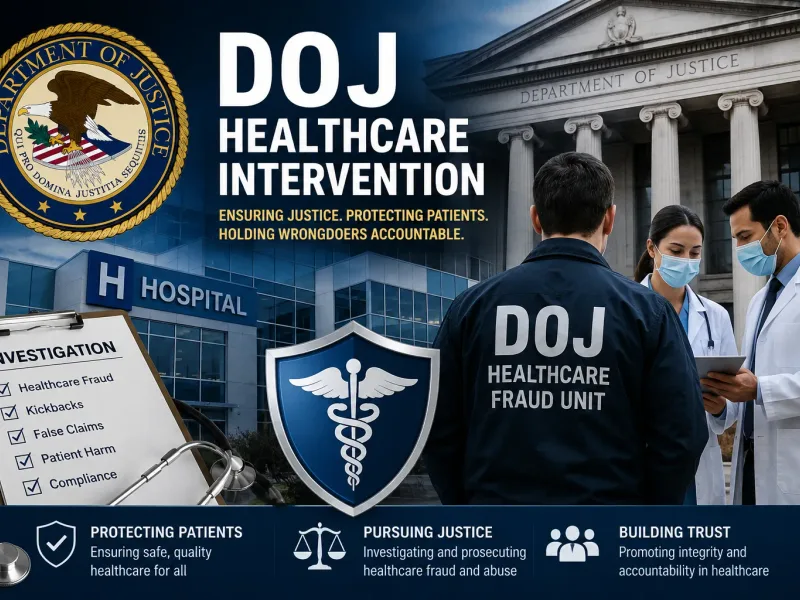
Healthcare fraud is not simply a billing problem. When false claims, unnecessary services or misleading records enter the system, the consequences can reach patients as well as taxpayers.
That is where DOJ healthcare intervention becomes significant. In the United States, the Department of Justice can investigate and prosecute alleged healthcare fraud, pursue civil cases and intervene in certain lawsuits brought under the False Claims Act. Recent enforcement activity shows that federal authorities are placing substantial attention on fraud involving Medicare, Medicaid and other healthcare programs.
For Indian readers, there is one useful distinction: the DOJ is a U.S. federal agency. Its healthcare enforcement work should not be confused with India's health regulators, courts or government health schemes.
What does DOJ healthcare intervention mean?
The word intervention can have a specific legal meaning. In some False Claims Act lawsuits, a whistleblower, known as a qui tam relator, files a case alleging that a person or organization defrauded the U.S. government. The government can investigate and decide whether to intervene and take over the litigation.
The DOJ has used this mechanism in healthcare cases involving allegations such as false Medicare billing, improper referrals and unnecessary medical services. Government intervention does not automatically mean that a defendant is guilty. Allegations still have to be resolved through the legal process.
Readers looking at the broader healthcare system can also explore Doctar's health blogs and medical insights, which cover healthcare access, doctors, hospitals, technology and patient-related topics.
Why would the DOJ step into a healthcare case?
The financial scale of healthcare programs makes fraud enforcement a major federal priority.
The DOJ's 2026 National Health Care Fraud Takedown resulted in charges against 455 defendants, including 90 doctors and other licensed medical professionals, in cases involving more than $6.5 billion in alleged fraud and opioid-related schemes. The department said the action involved 56 federal districts, 45 states and territories, and 50 state Medicaid Fraud Control Units. These figures describe allegations and charges, not proven guilt in every case.
The department has also described sophisticated cases involving digital health platforms, physician billing patterns, financial records and electronic evidence. That suggests modern healthcare enforcement is increasingly data-driven rather than based only on individual complaints.
For readers trying to understand the healthcare system from the patient side, Doctar's guide to Medicare and Medicaid differences provides useful background on the two U.S. programs.
What types of conduct can attract scrutiny?
Healthcare investigations can cover many forms of alleged misconduct. Examples include billing for services that were never provided, submitting claims for medically unnecessary services, misrepresenting patient conditions or receiving payments through deceptive arrangements.
Telemedicine has also become an area of enforcement interest. The DOJ's national enforcement history includes previous telemedicine-focused actions, while its 2026 cases included alleged large-scale digital healthcare fraud.
This is especially relevant as healthcare becomes more digital. Doctar's articles on telemedicine in India, free online doctor consultations, and telemedicine apps in India explain how remote care is changing access to doctors.
What happens during a DOJ healthcare investigation?
A healthcare investigation can involve several agencies and sources of evidence. DOJ prosecutors may work with the FBI, the Department of Health and Human Services Office of Inspector General, the Centers for Medicare & Medicaid Services and state authorities.
The evidence may include billing data, medical records, financial transactions, electronic communications and testimony. The DOJ says its Health Care Fraud Strike Force program has charged more than 6,200 defendants since 2007, involving more than $45 billion in collective alleged billing to federal healthcare programs and private insurers.
That makes accurate documentation more than an administrative chore. For patients, understanding how records are maintained can also matter when changing doctors or seeking another opinion. Doctar's guide to transferring medical records explains why continuity of records matters.
Why patients should care about healthcare enforcement
Patients may never see the courtroom, but healthcare fraud can still affect them.
A fraudulent claim can involve a service that was unnecessary, never delivered or inaccurately documented. In serious cases, questionable medical practices can expose patients to procedures, medications or follow-up care they did not actually need.
In clinical practice, this is often missed because the patient sees only the medical encounter, not the billing and administrative trail behind it. A claim can look like a routine paperwork issue until investigators discover a repeated pattern.
Patients can protect themselves by keeping copies of important medical records, asking questions about unfamiliar procedures and seeking clarification when a bill does not match the care they remember receiving.
Doctar also provides practical information on understanding online doctor ratings and navigating a possible misdiagnosis.
DOJ intervention is not the same as a medical decision
One point deserves emphasis: DOJ intervention is a legal and enforcement process, not a medical treatment decision.
A federal investigation does not determine whether a patient should start, stop or change treatment. Those decisions belong with appropriately qualified healthcare professionals who can assess the individual clinical circumstances.
Patients looking for care can use Doctar to find a general physician, find cardiologists in Kolkata, or explore dermatologists in Kolkata when specialist care is needed.
Hospital choice matters too. Doctar maintains information on facilities such as Desun Hospital in Kolkata and TRA General Hospital in Kolkata.
The wider lesson for healthcare organizations
Healthcare providers should treat compliance as part of patient safety, not merely as an accounting exercise.
Clear documentation, accurate coding, appropriate clinical justification and proper handling of patient information can reduce the risk of serious problems. Organizations working with digital healthcare should also understand how technology, billing systems and clinical records interact.
For patients, the practical lesson is simpler: keep your records, understand your care and ask questions when something does not make sense.
Doctar's resources on doctor consultation fees, doctor home visits, and doctor-on-call services can help readers understand different ways of accessing care.