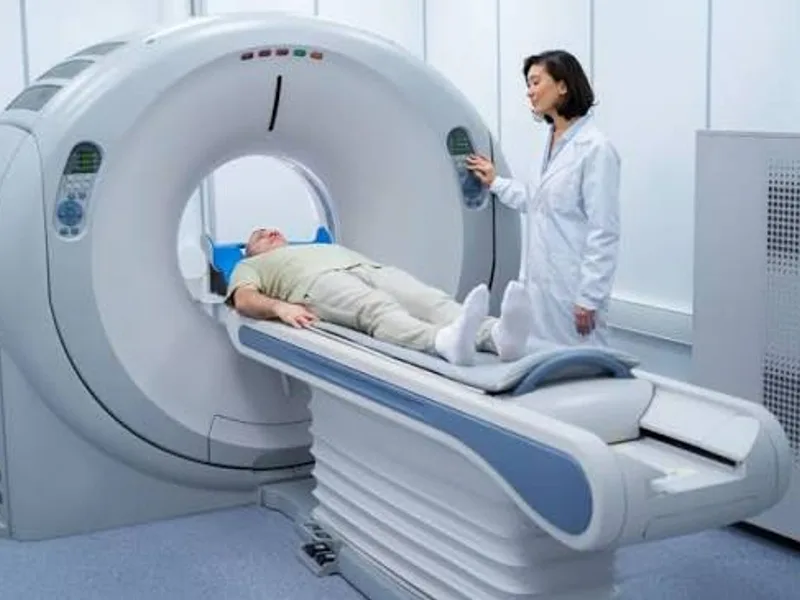
What is an MRI scan?
MRI stands for magnetic resonance imaging. It uses a strong magnetic field and radio waves to create detailed images of tissues and structures inside the body.
Unlike an X-ray or CT scan, MRI does not use ionising radiation. It is particularly useful for examining the brain, spine, joints, muscles, ligaments and other soft tissues. Doctar's MRI vs X-ray guide explains the practical differences between these imaging tests.
The test itself can take longer than an X-ray. Depending on the body part and protocol, a patient may need to remain still inside the scanner for roughly 30 to 60 minutes or longer.
MRI scan cost in India
For many patients, the first question is simple: “How much will I actually have to pay?”
A broad price range is more useful than pretending there is one national rate. Doctar's published comparison places MRI scans in India at around ₹3,000 to ₹15,000 or more, while specialised examinations and some private facilities can cost more.
The exact quotation should come from the diagnostic centre. Before booking, ask whether the quoted amount includes the radiologist's report, contrast material, consumables and any additional sequences that may be required.
Doctar's diagnostic-centre search allows users to look for imaging and diagnostic facilities by location and filter for services such as MRI, CT and other tests.
Why does MRI cost vary so much?
The biggest factor is the part of the body being examined. A routine scan of one region may cost less than a more specialised study involving multiple areas or a detailed protocol.
The machine and facility also matter. Large private hospitals may charge more because the scan is part of a broader hospital infrastructure, while standalone imaging centres may have different pricing.
Location can influence the bill as well. Prices in major cities may differ from those in smaller towns, and government facilities can have different fee structures from private centres.
Doctar's article on orthopaedic consultation fees in India also points out that imaging such as MRI is often billed separately from a doctor's consultation.
Brain MRI, spine MRI and joint MRI
“An MRI” is not one single test. The cost depends partly on the clinical question the doctor is trying to answer.
A brain MRI may be requested when a doctor needs detailed images of the brain or surrounding structures. The scan may sometimes be combined with specialised sequences or vascular imaging depending on the suspected condition.
Spine MRI is commonly used to assess structures such as discs, the spinal cord and surrounding soft tissues. A joint MRI may examine cartilage, tendons, ligaments and other structures that are not always clearly visible on a plain X-ray.
Doctar's article on MRI findings in multiple sclerosis is another example of how MRI can provide detailed information about the brain.
Does contrast increase MRI cost?
Sometimes. Contrast is a substance administered during certain MRI examinations to make particular tissues or abnormalities easier to see.
Not every MRI requires contrast. The decision depends on the medical question, the body part being examined and the radiologist's or referring doctor's assessment.
If contrast is recommended, ask the imaging centre whether it is already included in the quoted MRI price. Otherwise, the final bill may be higher than the initial advertised rate.
Patients should also tell the doctor and MRI staff about kidney problems, previous reactions to contrast agents, pregnancy and other relevant medical information before the examination.
MRI cost at a diagnostic centre vs hospital
A standalone diagnostic centre may offer a different price from a multispecialty hospital. Neither price automatically tells you which facility provides the better examination.
What matters is whether the facility has appropriate MRI equipment, trained technical staff and qualified radiology reporting. Turnaround time can matter too, particularly when the result is needed for a treatment decision.
For example, Doctar lists Agrawal Advanced Imaging Center in Akola, which provides MRI and CT imaging alongside other radiology services.
In Kolkata, Doctar lists hospitals with MRI facilities, including AMRI Hospital, PG Hospital / IPGMER and SSKM Hospital and Bidhannagar Sub-Divisional Hospital. These listings show MRI among the available facilities, but patients should confirm current availability and pricing directly.
Other Kolkata listings include Naihati Municipal Hospital, North City / Anandalok Hospital and Kasturi Medical Research Centre. Their Doctar profiles list MRI among their imaging facilities.
MRI prices can differ by city
There is no reliable reason to assume that an MRI will cost the same in Delhi, Mumbai, Kolkata, Chennai or a smaller city.
Doctar's radiology-centre search lets users search for centres offering X-ray, CT and MRI services by location. The platform also provides city-level diagnostic searches for many Indian cities.
For Mumbai, Doctar lists facilities such as Balaji Speciality Hospital and Bhartiya Arogya Nidhi Hospital, both of which list MRI among their imaging services.
In Bengaluru, Doctar lists Pristine Hospital and Aasra Hospital, both with MRI facilities listed in their profiles.
For Hyderabad, Princess Esra Hospital lists both CT and MRI services. In Chennai, RPS Hospital lists MRI alongside its broader diagnostic services.
Government hospitals may have different pricing
Government hospitals can sometimes offer imaging at lower or subsidised rates, but access, eligibility, waiting times and appointment systems vary.
Doctar's government hospital listings can help patients identify facilities in their area. For example, West Bengal Government TB Hospital lists MRI and CT facilities, while PG Hospital / SSKM also lists MRI among its diagnostic facilities.
The cheapest listed price is not always the most practical option. A patient may need to consider travel, waiting time, report availability and whether the required MRI protocol is offered.
Does health insurance cover MRI?
Coverage depends on the insurance policy and the reason for the scan. An MRI ordered as part of an approved medical evaluation or hospital treatment may be handled differently from an imaging test obtained independently.
Before the scan, check whether pre-authorisation is required and whether the centre is part of your insurer's network. Also ask whether you have a deductible, co-payment or other out-of-pocket expense.
Doctar's MRI insurance coverage guide explains the general relationship between insurance coverage and MRI costs, although the article discusses Medicare and should not be treated as an Indian insurance policy guide.
What should you ask before booking?
Before paying for an MRI, ask five practical questions:
What is the total price?
Is contrast included if the doctor has requested it?
Which body part and MRI protocol are included?
How long will the scan and report take?
Who will interpret and report the images?
In clinical practice, this is often missed because patients focus on the advertised scan price and forget to ask what is actually included. A ₹4,000 quote and a ₹4,000 final bill are not necessarily the same thing if contrast, additional sequences or other charges are added later.
Do you always need an MRI?
No. An MRI is a powerful diagnostic test, but more imaging is not automatically better.
The decision should come from the clinical situation. A doctor may recommend an X-ray, ultrasound, CT scan, MRI or no imaging at all depending on the symptoms and suspected condition.
Doctar's diagnostic-centre directory includes MRI, CT, ultrasound and other imaging categories, making it possible to compare available diagnostic options by location.
For example, Doctar's MRI versus X-ray guide explains why MRI is particularly useful for soft tissues while X-rays are often used for bones and other indications.
What can make an MRI more expensive?
Several factors can push the bill upward:
Contrast-enhanced imaging
More than one body region
Specialised MRI protocols
Private hospitals
Higher-end or specialised imaging centres
Sedation or additional medical support when clinically required
Faster reporting or other centre-specific services
The exact combination varies, so a phone call to the centre before booking can prevent surprises.
Practical takeaway
If you are comparing MRI scan cost, do not choose a centre based on the headline price alone. Confirm the body part, scan protocol, contrast requirement, reporting fee, appointment availability and total payable amount.
A reasonable price is useful, but the scan also needs to answer the medical question your doctor is asking. If you have already been advised to get an MRI, take the prescription or referral with you and confirm with the imaging centre exactly what examination has been requested.