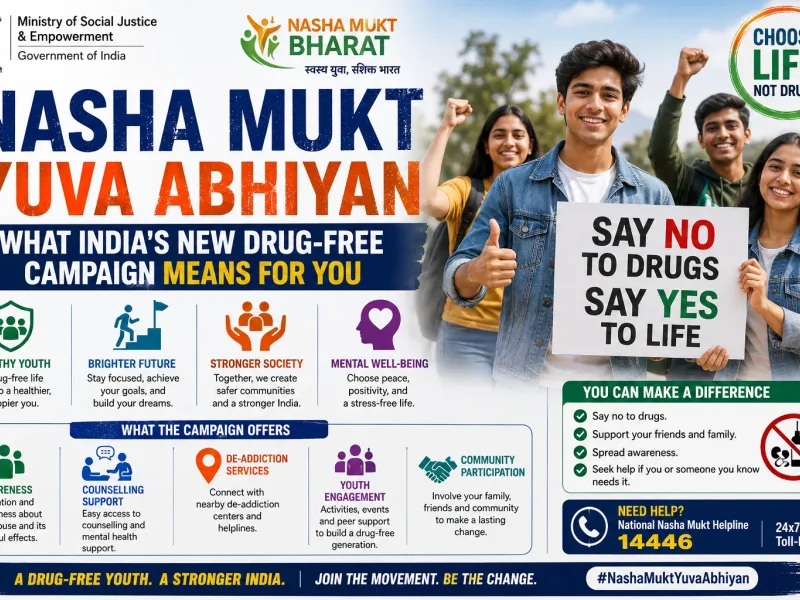
India's Biggest Anti-Drug Drive Just Got a 100-Week Roadmap
On August 2, 2026, Prime Minister Narendra Modi launched the Nasha Mukt Yuva for Viksit Bharat Sankalp Abhiyan through video conferencing — a 100-week nationwide campaign against substance abuse aimed at inspiring youth to stay away from drugs and become ambassadors of positive change in their communities.
That is a serious commitment. Not a rally, not a one-day event — but a structured, weekly programme running every Sunday across the country for nearly two years.
At the launch, over one crore young citizens joined through video conferencing from more than 28,000 locations across India. Numbers like that are hard to dismiss.
What Does the Campaign Actually Do?
The initiative seeks to bring educational institutions, youth organisations, civil society groups, industry bodies, and spiritual organisations together on a common platform to strengthen the collective movement against substance abuse. The activities are deliberately varied — sports events, walkathons, meditation sessions, cultural programmes, awareness drives, nukkad nataks (street plays), discussion forums, art competitions, and community engagement programmes.
This is not just government signage on a wall. The weekly Sunday model is designed to build habit and momentum. Think of it as a public health intervention dressed in the language of community participation — because that is exactly what it is.
PM Modi described the coming 100 Sundays as "100 strong steps in the direction of a completely drug-free India."
Whether the grassroots delivery matches that ambition will depend on how seriously local bodies follow through. That part remains to be seen.
This Campaign Didn't Appear Overnight
It is worth knowing that this is not India's first formal push against substance abuse. The Nasha Mukt Bharat Abhiyaan was launched on August 15, 2020, and since then has reached over 20 crore individuals, including more than six crore youth and over four crore women, across 5.71 lakh educational institutions.
By early 2026, the campaign had reached over 25 crore people, with a toll-free helpline — 14446 — set up for primary counselling and referral services. The new Nasha Mukt Yuva Abhiyan is, in effect, a significantly scaled-up and more structured continuation of that work.
If you or someone you know is struggling right now, that helpline number — 14446 — is worth saving.
Why Substance Abuse Is a Health Problem, Not Just a 'Character Flaw'
This is where the public conversation often gets stuck. In clinical practice working with patients who have substance use disorders — or speaking with the families of those patients — one thing comes up repeatedly: shame delays treatment. Families wait months, sometimes years, before seeking help, because addiction is still seen as a moral failure rather than what it actually is: a medical condition.
Substance use disorder — the clinical term for addiction — involves real changes in how the brain processes reward, decision-making, and impulse control. These are not abstract concepts; they show up on brain scans and respond to treatment. No one chooses to become dependent on a substance, though many people make the initial choice to try one.
If you're concerned about someone close to you, speaking with a early is far more effective than waiting for a crisis.
Who Is Most at Risk?
The campaign specifically targets youth — and for good reason. Adolescence and early adulthood are when substance use typically begins. Experts have pointed out that drugs don't just ruin a person, but spiral through the whole family and hinder national productivity. That is not an exaggeration. The social and economic cost of untreated addiction is genuinely significant.
Risk factors include peer pressure, stress (including academic pressure), exposure to substances at home, and easy availability — particularly in states and districts where supply chains for illicit drugs are well established. Children who have experienced trauma or who have untreated mental health conditions are at notably higher risk.
Parents who notice sudden changes in their teenager's behaviour — withdrawal from family, dropping grades, changed sleeping patterns, or unexplained money shortages — should consult a general physician or a rather than assuming it is "just a phase."
The Role of Physical and Mental Wellness in Prevention
One of the smartest things about the Nasha Mukt Yuva campaign's design is its inclusion of sports, meditation, and cultural activities alongside awareness drives. This is intentional. Physical activity and structured social engagement genuinely reduce the risk of substance use by giving young people alternative sources of dopamine — the brain's reward chemical.
Physiotherapy and fitness support for injuries can also matter here: young athletes who experience sports injuries and receive inadequate pain management are sometimes the ones most exposed to painkiller misuse. It is a clinical reality that tends to be underreported in India's public health conversation.
Mental health care is equally central. Anxiety, depression, and trauma are among the most common underlying conditions in people who develop substance dependencies. Normalising access to a psychiatrist or counsellor — particularly for adolescents — is as important as any public awareness campaign.
What Families Can Actually Do Right Now
Awareness campaigns are useful. But they work best when they push people toward action, not just information. Here is what you can do without waiting for a Sunday programme:
Talk openly at home. Research consistently shows that young people who have honest conversations about drugs with their parents are less likely to experiment. The conversation does not need to be a lecture.
Know the warning signs. Sudden secrecy, red eyes, unexplained tiredness or hyperactivity, money going missing, new friends who won't come to the house — these are not proof of anything, but they are worth addressing directly.
Seek help without shame. India has de-addiction centres, NIMHANS (National Institute of Mental Health and Neurosciences) affiliated facilities, and government-run rehabilitation services. You can also find a qualified psychiatrist near you through platforms like Doctar and book an appointment without the usual wait.
Use the helpline. The national de-addiction helpline 14446 provides primary counselling and referrals. It is free and confidential.
The Bigger Picture: Health and a Developed India
Union Minister Mansukh Mandaviya noted at the launch that a developed nation can only be built when its citizens are healthy — and that healthy individuals create a healthy society, which in turn lays the foundation for a prosperous country.
That framing is worth taking seriously. The Nasha Mukt Yuva Abhiyan connects individual health to national ambition. Whether you agree with the politics or not, the health argument stands on its own: a generation caught in substance dependence cannot participate fully in education, work, or family life.
The campaign links a developed India directly to a healthy younger generation. That is a public health statement as much as a political one.
Where to Find Support Near You
If this article has prompted you to seek support — for yourself or someone you care about — here are some relevant resources on Doctar: