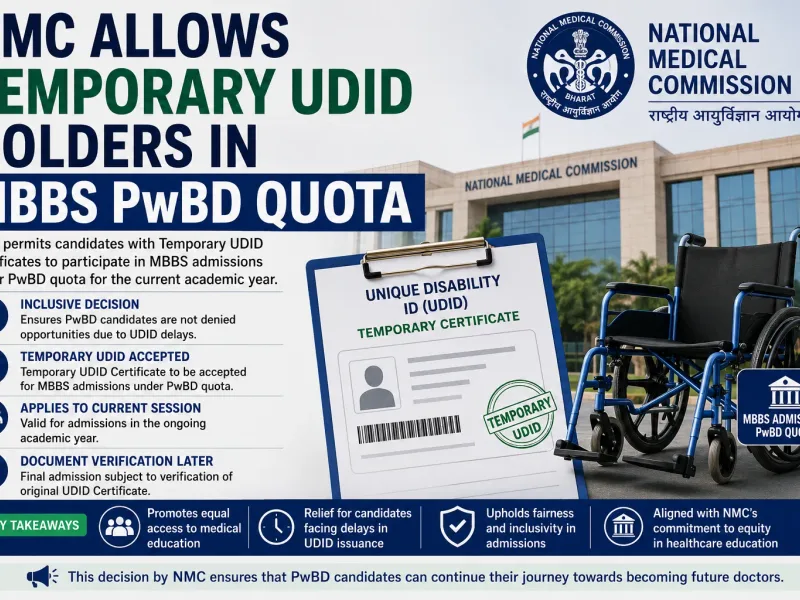
The Rule That Almost Left Thousands Behind
On July 27, 2026, the National Medical Commission (NMC) issued a notification stating that every candidate applying under the PwBD category must hold a valid Permanent UDID Card. For hundreds of disabled medical aspirants holding temporary cards, that single line was terrifying.
Then, nine days later, the NMC issued a clarifying addendum. Issued on August 5, 2026, the clarification confirmed that temporary UDID and disability certificate holders cannot be denied consideration under the PwBD quota. One notification caused the panic. The other resolved it — but only if candidates knew to look for it.
If you are a PwBD aspirant or the parent of one, this is the update that matters most right now ahead of NEET UG 2026 counselling.
What Is the UDID Card and Why Does It Matter?
UDID stands for Unique Disability ID. It is a government-issued identity card for persons with disabilities in India, administered by the Department of Empowerment of Persons with Disabilities (DEPwD) under the Ministry of Social Justice and Empowerment. Think of it as the disability equivalent of Aadhaar — a single document that officially recognises a person's disability and entitles them to government benefits, reservations, and schemes.
Under the NMC's revised framework for MBBS admissions, eligible PwBD candidates must file a valid Unique Disability ID card, submit a self-certified affidavit listing functional capabilities and limitations, and undergo verification by one of the 16 designated medical boards set up across the country. The UDID card is the gateway document to this entire process.
The problem: UDID cards come in two forms. A Permanent UDID is issued when a disability is definitively assessed as stable. A Temporary UDID is issued when a disability is still being evaluated, is progressive in nature, or when the issuing authority needs more information. Many people with very real, lifelong conditions hold temporary cards — not because their disability is less severe, but because of bureaucratic timelines or medical complexity.
For disability-related health consultations or to connect with rehabilitation specialists, search for doctors near you on Doctar to find the right specialist for your needs.
What the August 5 Addendum Actually Says
The August 5 addendum aligns NMC's guidelines with an Office Memorandum issued by the Department of Empowerment of Persons with Disabilities (Divyangjan), Ministry of Social Justice and Empowerment, on December 17, 2025. In that memorandum, the Ministry had clarified that persons with benchmark disabilities that are progressive, non-progressive, or not likely to improve should not be denied statutory benefits merely because their disability certificate is temporary in nature.
In plain terms: the nature of your disability matters more than the type of card you hold. If your condition is real and documented, a temporary certificate cannot be used as a bureaucratic reason to exclude you.
The NMC stated that Clause 9.2 of its July 27 guidelines should be read harmoniously with the Rights of Persons with Disabilities Act, 2016, the Rights of Persons with Disabilities (Amendment) Rules, 2024, and the December 2025 Office Memorandum. The addendum, the Commission confirmed, forms an integral part of the guidelines issued on July 27, 2026 — not a separate document, but a mandatory clarification to be read alongside the original notification.
This matters enormously in practice. In disability documentation processes, temporary certificates are often not a sign of a minor condition — they are frequently issued to people with complex, progressive, or rare conditions where permanent assessment takes longer. Excluding them on a technicality would have been deeply unjust and legally inconsistent with existing disability rights legislation.
The Bigger Picture: What Changed in MBBS PwBD Admissions This Year
This addendum does not exist in isolation. It is part of a larger, meaningful shift in how India assesses disabled candidates for medical education.
The NMC has moved from rigid disability percentage-based evaluation of students' suitability for medical education to an individualised assessment of their abilities. Medical assessment boards determining PwBD eligibility for MBBS admissions must now provide detailed written orders, which can be challenged by aspirants before an appellate authority under the Directorate General of Health Services.
The new guidelines shift the focus to what a candidate can do rather than simply how much they are disabled. The affidavit format emphasises evaluation based on functional ability — mobility, communication, dexterity, comprehension — rather than arithmetic percentages.
This is a genuine improvement over the old system, where a fixed disability percentage threshold could disqualify a candidate regardless of their actual ability to study and practice medicine. The Supreme Court had earlier called the previous guidelines unconstitutional and discriminatory — and the NMC's 2025–26 overhaul is largely a response to that ruling.
The appeal mechanism is particularly significant. If a medical assessment board deems a candidate ineligible, that candidate can now formally challenge the decision before an appellate authority under the Ministry of Health and Family Welfare. That is a right that did not clearly exist before.
Candidates navigating disability-related healthcare assessments can find hospitals near you on Doctar that have rehabilitation and assessment services, or search for specialists near you who can support your documentation process.
What Documents Do PwBD Candidates Still Need?
The addendum helps temporary certificate holders — but it does not eliminate the documentation requirements. Every PwBD candidate still needs to assemble a clear file.
Candidates are required to submit a self-certified affidavit detailing the tasks they can and cannot perform, in addition to producing their UDID card and undergoing an evaluation by medical boards. The affidavit asks students to specify their ability to carry out essential tasks such as communication, mobility, writing, comprehension of medical terms, and vision-related functions.
Candidates must approach one of the 16 MCC-designated disability centres and submit all required documents to claim the PwBD reservation for AIQ seats.
So if you hold a temporary UDID or a temporary disability certificate, here is what this means in practical terms: your certificate remains valid for the purpose of claiming the PwBD quota. You still need to appear before the designated medical board in person. You still need to submit the self-certified affidavit. And your functional ability — what you can actually do — will be assessed independently by the board, not just read off your certificate.
If you need support preparing for a medical board assessment, consider booking a consultation with a general physician near you to understand your documented health status clearly before you attend.
Who Benefits Most From This Clarification?
Several categories of disabled students are directly affected by this addendum.
People with progressive neurological conditions — such as muscular dystrophy or multiple sclerosis — often receive temporary certificates because their condition changes over time and reassessment is built into the system. Under the earlier rigid reading of the July 27 notification, they could have been barred.
People with rare diseases, where definitive classification and permanent UDID issuance can take years due to limited specialist availability in India, are another major group. Their conditions are often severe and well-documented, but the paperwork lags behind.
People whose permanent UDID applications are pending — due to administrative backlogs in the UDID portal — may also carry valid temporary cards while waiting for permanent issuance. This group, particularly, faced an arbitrary deadline risk that the addendum now addresses.
If you or your child falls into any of these categories, search for disability specialists or neurologists near you on Doctar to ensure your medical documentation accurately reflects your functional status before board assessment.
What PwBD Aspirants Should Do Right Now
Counselling timelines are tight. The addendum has been issued, but the administrative process still requires candidates to act.
Get your documents in order immediately. Your UDID card — temporary or permanent — should be in hand. Your self-certified affidavit should be prepared in the prescribed format. And you should have already identified which of the 16 MCC-designated centres is nearest to you.
If you are awaiting specialist reports to support your affidavit, act on that this week, not next. Find specialist doctors near you on Doctar — whether you need a neurologist, an orthopaedic specialist, or a general physician to help compile your functional assessment documentation.
If you are unsure whether your condition qualifies as a "benchmark disability" under the Rights of Persons with Disabilities Act 2016 — which defines benchmark disability as a disability of 40% or more — speak to a doctor who can review your existing certificates and advise on your status. You can book a home visit from a doctor through Doctar if reaching a clinic is difficult.
H3: A Note on the Appeal Process
The new framework includes something disability advocates have long asked for — a proper appeals mechanism. Candidates can challenge medical board decisions before an appellate authority under the Directorate General of Health Services, Ministry of Health and Family Welfare.
If a board denies your eligibility and you believe the decision is wrong, document everything. Get the written order the board is now obligated to provide. Seek independent medical opinion. And engage the appellate process formally. It exists precisely for situations like this.
For specialist medical opinions to support an appeal, search for doctors by speciality on Doctar to find the right clinical voice for your case.
Related Health Reading on Doctar
Understanding disability and health rights sits at the intersection of medicine and policy. The Doctar health blog covers related topics that may be helpful: