

Emergency & Help
24/7 Emergency & General Advisory
🚨 24/7 Medical Emergency
Non-Emergency Advisory
10:00 AM – 6:00 PM, Mon–Sat
For appointments & general queries.
24/7 Emergency & General Advisory
🚨 24/7 Medical Emergency
Non-Emergency Advisory
10:00 AM – 6:00 PM, Mon–Sat
For appointments & general queries.
Learn about the unicornuate uterus, a condition where only half the uterus forms. Understand its impact on fertility and pregnancy, potential risks, and how to navigate conception and delivery with expert medical care.

Discovering you have a unicornuate uterus can bring a wave of questions, especially if you're planning a family. It's a condition where the uterus forms with only one half, often leading to a single fallopian tube and a smaller uterus. While this diagnosis might sound daunting, it's essential to know that many women with a unicornuate uterus go on to have successful pregnancies. This guide aims to provide clear, practical information for Indian readers, covering what a unicornuate uterus is, how it can affect fertility, potential risks during pregnancy, and strategies to navigate these challenges with your healthcare provider.
Imagine your uterus developing from two parts that usually fuse together. In a unicornuate uterus, only one of these parts forms. This results in a uterus that's shaped like a banana or a horn (hence, 'unicornuate'), typically smaller than average and often accompanied by a single fallopian tube. This is a congenital condition, meaning it's present from birth and is a result of genetic factors. It's not something you did or could have prevented. For many, it goes unnoticed until they start trying to conceive and face difficulties or experience recurrent miscarriages.
It's important to remember that reproductive anatomy varies, and a unicornuate uterus is just one of these variations. While it's a rare condition, affecting an estimated 0.1% of women, it accounts for about 2.4% to 13% of all female reproductive tract abnormalities. This means that while the condition itself is uncommon, among women with uterine abnormalities, it's a more significant factor.
The unique structure of a unicornuate uterus can present challenges for conception and carrying a pregnancy to term. These challenges are often related to the reduced size of the uterus and its blood supply.
While many women with a unicornuate uterus can conceive naturally, some may experience difficulties. Research suggests that women with this condition might have a slightly lower success rate with fertility treatments like In Vitro Fertilization (IVF). For instance, one study indicated that after one IVF cycle, about 53.1% of women with a unicornuate uterus achieved pregnancy, compared to 65.7% of women with a typically formed uterus. The exact reasons for this difference are still being researched, but theories suggest that the smaller uterine cavity and potentially less optimal blood flow might play a role.
For women who do conceive, a unicornuate uterus can increase the risk of certain pregnancy complications. These are primarily due to the uterus being smaller and having a single artery for blood supply, rather than the typical two.
It's important to approach these statistics with context. Many studies on unicornuate uterus are based on small sample sizes due to the rarity of the condition. Therefore, while these risks are acknowledged, they do not predict the outcome of every pregnancy.
Consider Priya, a 30-year-old from Mumbai who had been trying to conceive for over a year without success. After undergoing various tests, she was diagnosed with a unicornuate uterus. She felt overwhelmed, fearing her dream of motherhood was over. Her gynecologist, however, reassured her, explaining that while there might be challenges, many women like her have healthy pregnancies with the right care and monitoring.
Often, a unicornuate uterus is discovered incidentally during an investigation for infertility or recurrent miscarriages. The diagnostic tools commonly used include:
The key to a successful pregnancy with a unicornuate uterus lies in proactive management and close collaboration with your healthcare team. Here’s what you can expect and what you can do:
Your doctor will be your most important ally. They will assess your specific situation, discuss potential risks, and create a personalized management plan. This often involves:
While medical management is paramount, maintaining a healthy lifestyle can also support your pregnancy journey.
A unicornuate uterus is a congenital condition, meaning it develops during fetal development. There are no known ways to prevent it, nor are there specific risk factors that you can control. It's simply a variation in how the reproductive organs formed. The most important takeaway is that it's not anyone's fault.
Yes, many women with a unicornuate uterus can conceive naturally. However, some may experience challenges, and fertility treatments might be considered.
The primary risks include miscarriage, preterm birth, placental problems, and a higher likelihood of cesarean delivery. However, with careful medical management, these risks can be significantly mitigated.
While there is an increased risk of needing a cesarean delivery, it's not guaranteed. Your doctor will assess your pregnancy and make the best recommendation for delivery.
Currently, there are no surgical procedures to correct the shape of a unicornuate uterus. Management focuses on supporting a pregnancy with the existing anatomy.
If you are trying to conceive and experiencing difficulties, or if you have a history of miscarriages, it is essential to consult a gynecologist. If you have been diagnosed with a unicornuate uterus, seek specialized prenatal care as soon as you confirm your pregnancy. Early consultation and consistent medical guidance are your best tools for a healthy pregnancy journey.
Visit Hospital
Near You

A cesarean section (C-section) is a surgical delivery in which a baby is born through an incision in the mother's abdomen and uterus. In Kolkata, several experienced obstetricians and well-equipped hospitals offer C-section services for planned and emergency deliveries. Understanding when a C-sectio
July 31, 2026
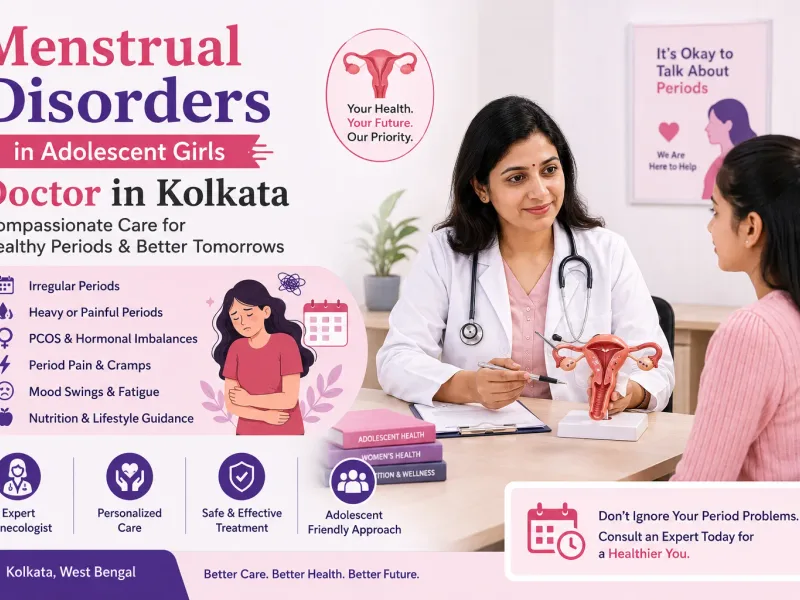
If you are searching for a Menstrual Disorders in Adolescent Girls Doctor in Kolkata, early evaluation by an experienced gynecologist can help identify the underlying cause of irregular or painful periods. While menstrual irregularities are common during the first few years after puberty, persistent
July 31, 2026

If you are searching for a Fibroid & Endometriosis doctor in Kolkata, choosing an experienced gynecologist with expertise in minimally invasive gynecological surgery is essential. Uterine fibroids and endometriosis are two common but different conditions that can cause pelvic pain, heavy menstrual b
July 31, 2026