Anxiety Disorder: Causes, Symptoms, Types & Treatment
Introduction
Everyone feels anxious at times — before an exam, a job interview, or a difficult conversation. But when anxiety becomes persistent, overwhelming, and interferes with daily life, it becomes an anxiety disorder. Anxiety disorders are the most common mental health conditions worldwide, affecting more than 300 million people globally. In India, studies suggest that nearly 45 million people are affected. Despite being highly treatable, anxiety disorders are often dismissed, minimised, or mistaken for personality traits. Understanding anxiety disorders — their causes, symptoms, and proven treatments — is essential for breaking the cycle of unnecessary suffering.
What is Anxiety Disorder?
Anxiety disorders are a group of mental health conditions characterised by excessive, persistent fear, worry, or nervousness that is disproportionate to the actual threat. Unlike ordinary anxiety, which is temporary and linked to a specific situation, anxiety disorders are chronic and can interfere significantly with daily activities, relationships, and physical health. The major types include:
Generalised Anxiety Disorder (GAD): Excessive worry about multiple everyday matters
Panic Disorder: Recurrent, unexpected panic attacks
Social Anxiety Disorder (Social Phobia): Intense fear of social situations
Specific Phobias: Extreme fear of particular objects or situations
Separation Anxiety Disorder: Fear of being separated from attachment figures
Agoraphobia: Fear of situations where escape may be difficult
How the Nervous System is Affected
Anxiety triggers the body's "fight-or-flight" response — a survival mechanism controlled by the sympathetic nervous system. In people with anxiety disorders, this response is activated too easily or stays switched on too long. The amygdala (the brain's fear centre) becomes hyperactive, sending alarm signals even when there is no real danger. The prefrontal cortex, which normally regulates and calms the amygdala, is less effective in people with anxiety disorders. Key neurotransmitters involved include serotonin, GABA, noradrenaline, and glutamate. Chronically elevated cortisol (stress hormone) affects the hippocampus, impairs memory, and perpetuates the cycle of anxiety.
Causes and Risk Factors
Anxiety disorders arise from a complex interplay of factors:
Biological Factors:
Family history — anxiety disorders run in families; genetic factors account for 30–40% of risk
Brain chemistry imbalances — particularly in serotonin and GABA systems
Underlying medical conditions — thyroid disorders, heart arrhythmias, and chronic illness can trigger anxiety
Hormonal fluctuations — particularly during puberty, pregnancy, and menopause
Psychological Factors:
Trauma — abuse, neglect, accidents, or witnessing violence
Chronic stress — financial difficulties, relationship problems, work pressure
Negative thinking patterns — perfectionism, catastrophising, or excessive self-criticism
Environmental Factors:
Childhood adversity or instability
Significant life changes — moving, job loss, bereavement
Social isolation or loneliness
Early Warning Signs
Anxiety disorders often develop gradually. Early indicators include:
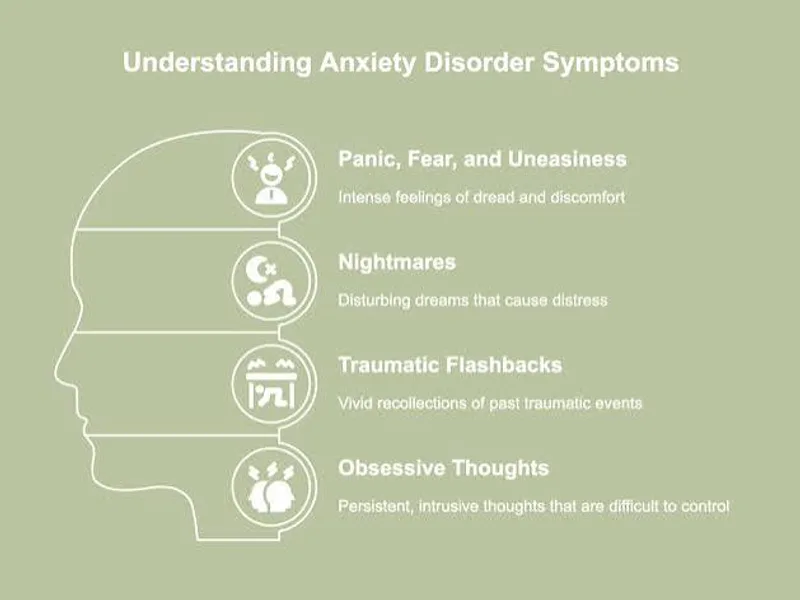
Excessive worrying that is difficult to control
Feeling "on edge," restless, or keyed up most of the time
Sleep difficulties — particularly trouble falling asleep due to racing thoughts
Becoming irritable more easily than usual
Difficulty concentrating or mind going blank
Avoiding situations that provoke anxiety (which worsens the disorder over time)
Seeking excessive reassurance from others
Common Symptoms
Anxiety manifests across physical, cognitive, and behavioural domains:
Physical Symptoms:
Palpitations, racing heart, or chest tightness
Shortness of breath
Sweating, trembling, or shaking
Dizziness or light-headedness
Nausea, stomach upset, or diarrhoea
Muscle tension or headaches
Dry mouth and difficulty swallowing
Cognitive Symptoms:
Persistent, intrusive worries
Catastrophic thinking ("What if the worst happens?")
Difficulty concentrating
Heightened vigilance — scanning for threats constantly
Behavioural Symptoms:
Stages of the Disease
Mild Anxiety
Manageable levels of worry and physical symptoms. The person can still function well in daily life but notices increasing tension and mental preoccupation.
Moderate Anxiety
Anxiety begins to interfere with work, relationships, or daily activities. Physical symptoms are more prominent. Avoidance behaviours start to narrow the person's life.
Severe Anxiety
Daily functioning is significantly impaired. Panic attacks may be frequent. The person may be unable to work, socialise, or leave home. Co-occurring depression is common at this stage.
How Doctors Diagnose the Condition
Diagnosis is clinical and is based on a thorough assessment:
Clinical interview — exploring the nature, duration, and impact of symptoms
Standardised rating scales — the Generalised Anxiety Disorder-7 (GAD-7), PHQ-9 (for co-occurring depression), and Hamilton Anxiety Rating Scale
Medical examination — to rule out physical causes such as hyperthyroidism, cardiac arrhythmias, or medication side effects
Blood tests — thyroid function, blood glucose, and full blood count
Psychological assessment — to understand cognitive patterns and coping strategies
For cases involving physical symptoms that are difficult to distinguish from medical conditions, a referral may be appropriate. If cardiac symptoms are prominent, a Cardiologist may be consulted to rule out heart disease. If thyroid dysfunction is suspected, an Endocrinologist should be involved in the assessment.
Available Treatment Options
Anxiety disorders are among the most treatable mental health conditions. Most people experience significant improvement with the right combination of therapy and, where needed, medication.
Medications
Selective Serotonin Reuptake Inhibitors (SSRIs) — sertraline, escitalopram (first-line treatment; takes 2–4 weeks to work)
Serotonin-Norepinephrine Reuptake Inhibitors (SNRIs) — venlafaxine, duloxetine
Buspirone — non-sedating, non-habit-forming option for GAD
Benzodiazepines — (e.g., diazepam, clonazepam) — for short-term use only; carry significant risk of dependence
Beta-blockers — propranolol for situational anxiety (e.g., performance anxiety)
Pregabalin — used for GAD, particularly in people with pain disorders
Therapies
Cognitive Behavioural Therapy (CBT): The gold standard for anxiety disorders. Addresses the relationship between thoughts, feelings, and behaviours. Highly effective across all anxiety disorder types.
Exposure and Response Prevention (ERP): Particularly effective for specific phobias and OCD. Involves gradually facing feared situations.
Acceptance and Commitment Therapy (ACT): Helps patients accept anxious thoughts without being controlled by them.
Mindfulness-Based Stress Reduction (MBSR): Teaches present-moment awareness to reduce the power of anxious thoughts.
Eye Movement Desensitisation and Reprocessing (EMDR): Effective for anxiety rooted in trauma.
Lifestyle Management
Regular aerobic exercise is as effective as medication for some anxiety disorders
Limiting caffeine (a powerful anxiogenic)
Consistent sleep schedule
Mindfulness and meditation practice
Reducing alcohol use
Social connection and meaningful activity
Daily Living Tips for Patients
Learn to recognise your personal anxiety triggers
Practice slow, diaphragmatic breathing (4-7-8 breathing technique)
Use grounding techniques during acute anxiety (5-4-3-2-1 sensory grounding)
Break worries into actionable steps — distinguish between "solvable" and "hypothetical" worries
Engage in regular pleasurable activities that counteract avoidance
Communicate your needs to family members and close friends
Patients in Kolkata seeking specialised anxiety treatment can find comprehensive mental health and neurology services at Best Hospital for Anxiety Disorder in Kolkata.
Complications if Left Untreated
Untreated anxiety disorders can lead to:
Development of depression (anxiety and depression co-occur in over 50% of cases)
Substance abuse — alcohol and drugs used as self-medication
Social isolation and relationship difficulties
Occupational dysfunction — job loss, underperformance, missed opportunities
Physical health consequences — cardiovascular disease, weakened immunity, chronic pain
Increased risk of suicide in severe cases
Significant reduction in quality of life
Prevention and Risk Reduction
Develop healthy stress management skills early in life
Seek support promptly after trauma — early intervention prevents PTSD and anxiety disorders
Build social support networks — isolation fuels anxiety
Limit caffeine and avoid substance use
Practice regular mindfulness or relaxation techniques
Maintain a healthy, active lifestyle
Do not avoid anxiety-provoking situations excessively — gradual exposure is protective
Frequently Asked Questions (FAQs)
1. Is anxiety a sign of weakness? Absolutely not. Anxiety disorders have a biological basis involving brain chemistry and neurology. They affect people of all backgrounds, including highly accomplished individuals.
2. Can anxiety cause physical symptoms? Yes. Palpitations, chest tightness, nausea, dizziness, and muscle tension are all common physical symptoms of anxiety. This does not mean the symptoms are "not real."
3. What is a panic attack? A panic attack is a sudden surge of intense fear or discomfort that peaks within minutes, accompanied by physical symptoms like pounding heart, shortness of breath, dizziness, and a sense of impending doom.
4. How long does treatment take? Many people see significant improvement within 8–12 weeks of CBT. Some may need longer-term therapy or medication. Full recovery is achievable for most people.
5. Can children have anxiety disorders? Yes. Anxiety disorders are among the most common mental health conditions in children. Early identification and treatment are very important.
6. Do anxiety disorders go away without treatment? Mild anxiety sometimes improves with lifestyle changes. However, anxiety disorders typically persist or worsen without treatment. Seeking help early is always recommended.
7. Are anxiety and stress the same thing? No. Stress is a response to an external trigger, while anxiety is an internal, often self-perpetuating state that can exist without a clear external cause.
8. Is it possible to have more than one anxiety disorder? Yes. It is common to have two or more anxiety disorders simultaneously, and co-occurring depression is very frequent.
9. Can medication alone cure anxiety? Medication can significantly reduce symptoms, but it is most effective when combined with therapy. CBT addresses the underlying thinking patterns that sustain anxiety.
10. When should I seek professional help? If anxiety is interfering with your work, relationships, or daily life — or if you are avoiding situations, using alcohol to cope, or experiencing panic attacks — it is time to seek professional help from a qualified mental health professional or doctor.
Conclusion
Anxiety disorders are real, common, and highly treatable. Living with chronic anxiety does not have to be the norm. With the right combination of therapy, medication where needed, and lifestyle strategies, the vast majority of people with anxiety disorders experience significant and lasting improvement. If anxiety has been holding you back, taking the first step to seek professional support could be the most transformative decision you make. Help is available — and recovery is possible.