A Bundibugyo virus outbreak — a strain of Ebola disease distinct from the more widely known Zaire strain — was confirmed in the Democratic Republic of Congo (DRC) on May 15, 2026, and in Uganda shortly after. The World Health Organization declared it a Public Health Emergency of International Concern on May 17, 2026. As of early June, CDC reported 378 confirmed cases and 63 confirmed deaths across both countries, with no cases reported in the United States at that time.
That's the short version. The longer story involves a delayed diagnosis, a virus with no approved vaccine, and a risk picture that has shifted more than once since May.
The first recognized case wasn't flagged as Ebola right away. According to the World Health Organization's Disease Outbreak News, the earliest known suspected case — a health worker — developed fever, hemorrhaging, vomiting, and severe malaise on April 24, 2026, and died at a medical centre in Bunia. WHO says it was alerted on May 5, 2026, to an unknown, high-mortality illness in Mongbwalu Health Zone, Ituri Province, after four health workers died within four days. =
Lab confirmation followed roughly a week later. The CDC's Health Alert Network advisory states that laboratory analysis by the National Institute of Biomedical Research (INRB) confirmed Bundibugyo virus infection in 8 of 13 samples collected from patients in the Mongbwalu and Rwampara health zones. On May 15, 2026, the DRC Ministry of Health officially confirmed the outbreak, with 246 suspected cases and 80 deaths reported as of May 16.
Case counts rose quickly after that. WHO reported that by May 21, 2026, 746 suspected cases, including 176 deaths among suspected cases, had been recorded in DRC, along with 85 confirmed cases (two in Uganda) and 10 confirmed deaths (one in Uganda) — a case fatality rate of 12% among confirmed cases at that point. By early June, the CDC's MMWR field report put the confirmed total at 378 cases and 63 deaths across DRC and Uganda combined.
What Is Bundibugyo Virus, and How Is It Different?
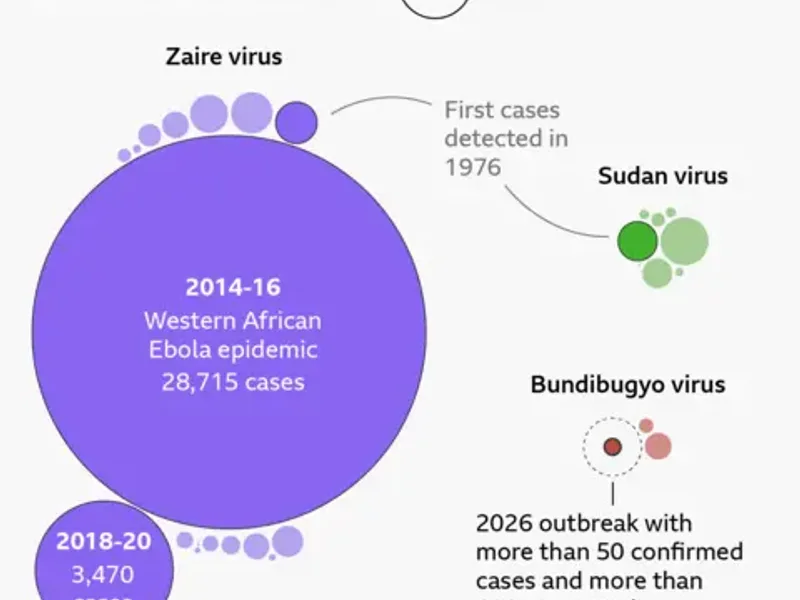
Bundibugyo virus is one of several species within the Ebola virus family, distinct from the Zaire strain responsible for the 2014 West Africa epidemic and the outbreaks that followed in DRC through the late 2010s and early 2020s. It's rarer and less studied, which has practical consequences for treatment.
The most important difference: unlike Ebola virus disease caused by the Zaire strain, there is currently no licensed vaccine or specific therapeutic against Bundibugyo virus, according to reporting compiled from WHO and OCHA outbreak data. Supportive care — IV fluids, electrolyte correction, and management of secondary infections — remains the primary treatment, and CDC notes that early supportive care is lifesaving even without a targeted drug.
This isn't Bundibugyo virus's first appearance. CDC's MMWR report notes the virus was first identified in 2007, when it caused an outbreak in Uganda with 149 suspected cases and 37 deaths, and a 2012 outbreak in DRC resulted in 56 laboratory-confirmed cases and 17 deaths. Historical case fatality rates for Bundibugyo outbreaks specifically have ranged from 30% to 50%, according to OCHA's ReliefWeb outbreak summary — serious, though somewhat lower on average than some Zaire-strain outbreaks have recorded.
Symptoms and Why Early Cases Get Missed
Bundibugyo virus disease presents with fever, generalized body pain, weakness, and vomiting, with bleeding in some cases as the illness progresses. CDC's advisory describes patients presenting with fever, generalized body pain, weakness, vomiting, and in some cases bleeding, with several patients deteriorating rapidly and dying.
The problem is that none of those early symptoms are specific to Ebola. Malaria, typhoid, and other endemic febrile illnesses in the region produce nearly identical opening symptoms, which is part of why the outbreak took roughly three weeks to be identified after the first known death.
How the Outbreak Reached Uganda
Outbreaks in this region rarely stay contained to one country, and this one didn't. Uganda's Ministry of Health confirmed Bundibugyo virus disease in an imported case — a Congolese man who had traveled from DRC and died in Kampala, the capital city.
Several structural factors made spread more likely. CDC's advisory points out that the outbreak is occurring in areas affected by insecurity, population displacement, mining-related population movement, and frequent cross-border travel, all of which may increase the risk of further transmission. Contact tracing in these conditions is genuinely difficult, even with international response teams deployed.
Risk to People Outside DRC and Uganda
This is the part most readers actually want answered, and it deserves a direct response rather than hedging.
As of CDC's most recent formal risk assessment, the agency assessed the risk to the U.S. population over the following three months as low, and stated that if cases were to arise in the United States, there is public health capacity to contain and control an outbreak. No domestic transmission has occurred.
That said, the situation isn't static. On July 10, 2026, CDC reported that a U.S. citizen working for a humanitarian organization in DRC had tested positive for Bundibugyo virus; the patient was medically evacuated to Germany on July 13, 2026. Europe's disease control agency responded by stating that the likelihood of infection for people living in the EU/EEA remains very low, while noting ongoing gaps in surveillance data from the outbreak zone. In practical terms: general public risk in North America,
Europe, and most of Asia remains low based on current data. Risk is meaningfully elevated for people with direct exposure — healthcare workers, aid workers, and close contacts of patients in DRC and Uganda, or anyone who has traveled through the affected provinces recently.
What CDC and WHO Are Doing
CDC's disease modeling team has been running outbreak projections to guide the response rather than just tracking case counts after the fact. Their MMWR modeling report found that assuming 50 cumulative deaths as of May 24, 2026, if 70% of patients were to enter isolation, only about one in 20 simulated scenarios projected the outbreak exceeding 10,000 cases within three months — a finding used to argue that case isolation, not vaccination (since none exists), is the primary lever available to control spread.
On the ground, WHO says its response includes deployment of rapid response teams, delivery of medical supplies, strengthened surveillance, laboratory confirmation, infection prevention and control assessments, and the set-up of safe treatment centers.
Frequently Asked Questions
What is Bundibugyo virus disease?
Bundibugyo virus disease is a type of Ebola disease caused by Bundibugyo virus, a distinct species within the Ebola virus family. It causes fever, body pain, weakness, vomiting, and sometimes bleeding, with a historical case fatality rate between 30% and 50%. Unlike the Zaire Ebola strain, there is no licensed vaccine for it.
Is the 2026 Ebola outbreak a risk to people outside Africa?
CDC assessed the risk to the U.S. population as low as of its most recent formal review, with no domestic transmission reported. A U.S. aid worker did test positive in DRC in July 2026 and was medically evacuated, but this reflects direct occupational exposure, not general community risk.
How is Bundibugyo virus different from the Ebola strain people usually hear about?
The strain most associated with major outbreaks, including 2014's West Africa epidemic, is Zaire ebolavirus, which has an approved vaccine. Bundibugyo virus is a separate, rarer species with no licensed vaccine or specific antiviral treatment, so supportive care is the only medical option currently available.
What are the early symptoms of Bundibugyo virus disease?
Early symptoms include fever, generalized body pain, weakness, and vomiting — symptoms that closely resemble malaria or typhoid fever, which are more common in the affected region. Bleeding and rapid deterioration can follow in more severe cases, which is why early cases are often initially misdiagnosed.
How did the outbreak reach Uganda?
Uganda confirmed one imported case: a man who had traveled from DRC's outbreak zone and died in Kampala. Given cross-border travel, mining-related population movement, and regional instability, health officials flagged an elevated risk of further cross-border spread
5. Sources
CDC Health Alert Network — Ebola Disease Outbreak in the Democratic Republic of the Congo and Uganda, HAN00530
CDC MMWR — Notes from the Field: Outbreak of Ebola Disease Caused by Bundibugyo Virus — DRC and Uganda, May 2026
CDC MMWR — Assessment of Risk to the U.S. Population from the Ebola Disease Outbreak Caused by Bundibugyo Virus, 2026
CDC MMWR — Modeled Scenario Projections for the Ebola Disease Outbreak Caused by Bundibugyo Virus, 2026
World Health Organization — Disease Outbreak News, Ebola disease caused by Bundibugyo virus – Democratic Republic of the Congo (DON602, DON603)
European Centre for Disease Prevention and Control (ECDC) — Ebola disease outbreak in the Democratic Republic of the Congo and Uganda
ReliefWeb/OCHA — DR Congo/Uganda: Ebola Outbreak – May 2026