Epilepsy Disease: Causes, Symptoms, Diagnosis & Treatment
Introduction
Epilepsy is one of the most common neurological disorders in the world, affecting approximately 50 million people globally — making it the fourth most prevalent neurological condition after migraine, stroke, and Alzheimer's disease. In India alone, an estimated 10–12 million people live with epilepsy. It is characterised by recurrent, unprovoked seizures — sudden bursts of abnormal electrical activity in the brain that can cause changes in behaviour, movement, sensation, or consciousness. Despite its prevalence, epilepsy is surrounded by significant stigma and misunderstanding. With modern medications and surgical advances, up to 70% of people with epilepsy can become seizure-free. This guide helps patients, families, and caregivers understand epilepsy and navigate the path toward effective management.
What is Epilepsy?
Epilepsy is a chronic neurological disorder defined by the occurrence of two or more unprovoked seizures, or one unprovoked seizure with a high risk of recurrence (above 60% over the next 10 years). A seizure is a sudden, temporary disruption in the brain's normal electrical activity. Epilepsy should be distinguished from a single provoked seizure — one caused by a transient, reversible factor such as fever, low blood sugar, or drug withdrawal.
Types of epilepsy are classified by the type of seizures involved:
Focal (partial) seizures — arising in one specific area of the brain
Generalised seizures — involving both hemispheres simultaneously from onset
Combined generalised and focal epilepsy
Unknown onset epilepsy
How the Nervous System is Affected
The brain functions through carefully coordinated electrical impulses between neurons. In epilepsy, this balance is disrupted — a group of neurons fires abnormally, excessively, and synchronously. This electrical storm can remain localised (focal seizure) or spread across the entire brain (generalised seizure). The nature of the seizure depends on which part of the brain is affected:
Frontal lobe: Motor movements, repetitive behaviours
Temporal lobe: Emotional changes, deja vu, lip-smacking (most common site for focal epilepsy)
Occipital lobe: Visual hallucinations or distortions
Whole brain: Loss of consciousness, convulsions (tonic-clonic seizure)
Between seizures, the brain may appear entirely normal — which is why epilepsy can be difficult to diagnose and why many people with epilepsy live very normal lives between episodes.
Causes and Risk Factors
In approximately 50% of cases, no specific cause can be found (idiopathic or genetic epilepsy). Known causes include:
Structural Causes:
Brain tumours
Stroke or cerebrovascular disease
Brain injury from head trauma
Cortical malformations (abnormal brain development before birth)
Hippocampal sclerosis (scarring, often from early febrile seizures)
Genetic Causes:
Mutations in ion channel genes (channelopathies) — SCN1A (Dravet syndrome), KCNQ2
Chromosomal conditions associated with epilepsy (Down syndrome, Angelman syndrome)
Infectious and Metabolic Causes:
Brain infections — meningitis, encephalitis, cerebral malaria, neurocysticercosis (particularly prevalent in India and other developing countries)
Metabolic disorders — hypoglycaemia, hyponatraemia
Autoimmune encephalitis
Risk Factors:
Family history of epilepsy
Prior brain injury, stroke, or infection
Neurodevelopmental disorders (autism, cerebral palsy)
Dementia (increases seizure risk in elderly)
Drug or alcohol withdrawal
Early Warning Signs
Some people experience warning signs before seizures:
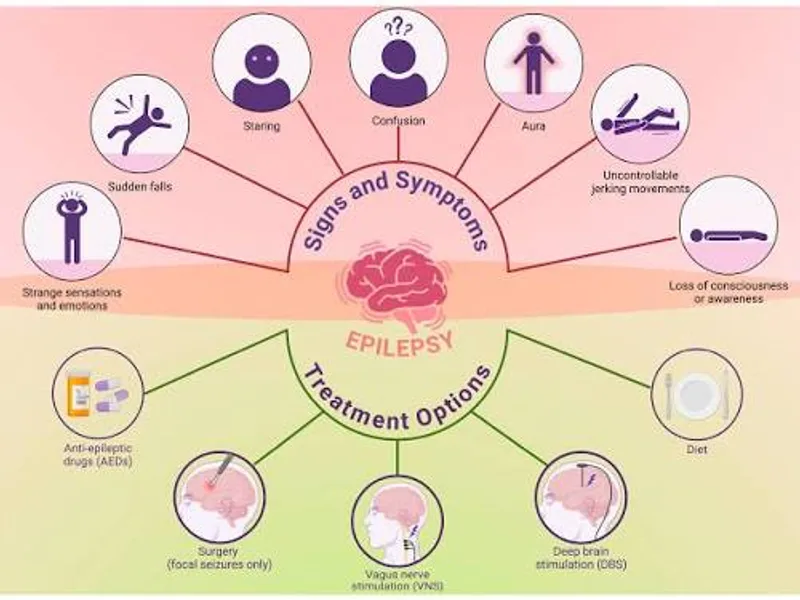
Aura: A brief subjective sensation that precedes some focal seizures — may include a rising feeling in the stomach, a strange smell, déjà vu, or visual changes
Brief episodes of staring or unresponsiveness
Unusual involuntary movements of one limb
Sudden brief jerks of the body (especially on waking — myoclonic jerks)
Episodes of confusion or memory gaps
An aura is itself a focal seizure and serves as an important warning — some people can use this time to sit down or move to a safe location.
Common Symptoms
Seizure symptoms vary widely depending on type:
Focal Aware Seizure (previously called simple partial)
Focal Impaired Awareness Seizure (previously complex partial)
Generalised Tonic-Clonic Seizure (previously grand mal)
Sudden loss of consciousness
Tonic phase: body stiffens, may cry out
Clonic phase: rhythmic jerking of limbs
Post-ictal: confusion, fatigue, headache, muscle soreness lasting minutes to hours
Absence Seizure (previously petit mal)
Myoclonic Seizure
Atonic Seizure ("drop attack")
Stages of the Disease
Newly Diagnosed Epilepsy
After first diagnosis, the goal is to find an effective medication with minimal side effects. Up to 70% of people achieve seizure control with the first or second medication tried.
Drug-Resistant Epilepsy
Defined as failure of adequate trials of two tolerated, appropriately chosen anti-seizure medications. Affects approximately 30% of people with epilepsy. Requires specialist evaluation for alternative medications, dietary therapies, or surgical assessment.
Epilepsy in Remission
Many people with epilepsy — particularly childhood epilepsy syndromes — go into prolonged remission and may eventually be able to discontinue medications under medical supervision.
How Doctors Diagnose the Condition
Epilepsy diagnosis requires a careful clinical and investigative approach:
Detailed seizure history — eyewitness account is invaluable; timing, duration, warning signs, movements, consciousness, and post-event state
EEG (Electroencephalogram): Records electrical activity of the brain. May show epileptiform discharges (spikes, sharp waves) even between seizures. Video-EEG monitoring is the gold standard for seizure classification.
Brain MRI: Essential for identifying structural causes — tumours, hippocampal sclerosis, cortical malformations. Should be performed in all new-onset epilepsy.
Blood tests: Glucose, electrolytes, liver and kidney function, and genetic testing where indicated
Neuropsychological testing: Assesses cognitive function and helps localise epileptic focus before surgery
For comprehensive epilepsy evaluation and management, consulting a specialist Neurologist with expertise in epilepsy (epileptologist) is essential. They can interpret EEG findings, choose the most appropriate medications, and assess suitability for surgical intervention.
Available Treatment Options
Medications
Anti-seizure medications (ASMs) are the cornerstone of epilepsy treatment. Common first-line options include:
Sodium valproate — broad-spectrum; highly effective for generalised epilepsy (avoid in women of childbearing potential due to teratogenicity)
Lamotrigine — well-tolerated; suitable for focal and generalised epilepsy; safe in pregnancy
Levetiracetam — broad-spectrum; rapid titration; widely used
Carbamazepine / Oxcarbazepine — first-line for focal epilepsy
Ethosuximide — specific for absence seizures
Topiramate, Lacosamide, Perampanel — newer agents for drug-resistant focal epilepsy
Clobazam — benzodiazepine used as add-on or for intermittent use (e.g., catamenial epilepsy)
Cannabidiol (Epidiolex) — approved for Dravet syndrome and Lennox-Gastaut syndrome
Therapies
Dietary Therapies:
Ketogenic diet: A high-fat, very low-carbohydrate diet that has significant evidence for drug-resistant epilepsy, particularly in children. Can reduce seizures by over 50% in many patients.
Modified Atkins Diet and Low Glycaemic Index Diet are less restrictive alternatives.
Neurostimulation:
Vagus Nerve Stimulation (VNS): A device implanted in the chest sends regular electrical pulses to the vagus nerve, reducing seizure frequency
Responsive Neurostimulation (RNS): A brain-implanted device that detects seizure onset and delivers responsive stimulation
Surgical Options: For carefully selected patients with drug-resistant focal epilepsy, surgery offers the possibility of seizure freedom. For patients requiring surgical evaluation, Deep Brain Stimulation Surgery and other neuromodulation procedures are available at specialised epilepsy surgery centres.
Surgical options include:
Resective surgery: Removal of the seizure focus (e.g., temporal lobectomy for hippocampal sclerosis — 60–70% seizure-free at 2 years)
Corpus callosotomy: Cutting fibres connecting the brain hemispheres to reduce drop attacks
Hemispherectomy/Hemispherotomy: For catastrophic hemispheric epilepsy in children
Lifestyle Management
Take medications consistently, at the same time each day
Maintain regular sleep patterns — sleep deprivation is a common seizure trigger
Limit alcohol consumption
Manage stress effectively
Wear medical identification (bracelet or card)
Inform relevant parties (school, employer, sports coaches) of the condition
Daily Living Tips for Patients and Caregivers
Seizure First Aid:
Stay calm and note the time the seizure starts
Move nearby sharp or hard objects away
Place something soft under the head
Turn the person gently onto their side (recovery position) — especially if there is vomiting
Do NOT restrain the person or put anything in their mouth
Call emergency services if the seizure lasts more than 5 minutes
Daily Safety:
Take showers rather than baths (drowning risk)
Avoid heights and open water when alone
Discuss driving restrictions with your neurologist (rules vary by country)
Cook safely — use back burners, microwave when possible
Consider seizure alert devices
Families across Kolkata can seek comprehensive epilepsy care including EEG facilities, specialist consultations, and surgical assessment at Best Hospital for Epilepsy in Kolkata.
Complications if Left Untreated
Uncontrolled epilepsy can lead to:
SUDEP (Sudden Unexpected Death in Epilepsy): Rare but serious; risk reduced by better seizure control
Physical injuries — fractures, head injuries, burns from seizure-related falls
Cognitive impairment — particularly in children with frequent seizures
Status epilepticus — a prolonged seizure requiring emergency treatment
Depression and anxiety (affect up to 50% of people with epilepsy)
Social stigma, educational difficulties, and employment barriers
Restrictions on driving and certain occupations
Prevention and Risk Reduction
While many epilepsies cannot be prevented, certain steps reduce risk:
Wear helmets and seatbelts to prevent head injury
Prompt treatment of brain infections (meningitis, encephalitis)
Ensure safe delivery practices to prevent birth-related brain injury
Vaccination against infectious diseases that can affect the brain
Manage cardiovascular risk factors to reduce stroke-related epilepsy
In countries where neurocysticercosis is common, proper food hygiene and sanitation are essential
Frequently Asked Questions (FAQs)
1. Is epilepsy a mental illness? No. Epilepsy is a neurological condition — a brain disorder — not a mental illness. Although people with epilepsy have higher rates of depression and anxiety, these are separate conditions.
2. Can epilepsy be cured? Some epilepsy syndromes (particularly childhood epilepsies) go into permanent remission. Surgical treatment can make many drug-resistant patients completely seizure-free. Most people, however, require long-term medication management.
3. Can people with epilepsy drive? This depends on the country, local laws, and how well seizures are controlled. In most countries, a seizure-free period (typically 6–12 months) is required before driving is permitted. Your neurologist will advise.
4. Is epilepsy hereditary? Some forms of epilepsy have a strong genetic basis. However, most epilepsies are not directly inherited. Having a first-degree relative with epilepsy slightly increases your risk.
5. Can epilepsy develop in adults? Yes. Epilepsy can begin at any age. New-onset epilepsy in adults (particularly over 60) is often related to stroke, brain tumours, or neurodegenerative diseases.
6. What triggers seizures? Common triggers include sleep deprivation, missed medications, alcohol, stress, flashing lights (photosensitive epilepsy), hormonal changes, and illness with fever.
7. What should I do if someone has a seizure? Stay calm, protect them from injury, time the seizure, do not restrain them or put anything in their mouth, and place them in the recovery position afterward. Call an ambulance if the seizure lasts more than 5 minutes.
8. Can women with epilepsy have children? Yes. Most women with epilepsy have healthy pregnancies and babies. Careful planning with a neurologist and obstetrician is essential to optimise medication safety during pregnancy.
9. Are all seizures the same? No. Seizures vary enormously — from brief staring spells (absence seizures) to full convulsions (tonic-clonic seizures). The type of seizure influences treatment choice.
10. When should someone with epilepsy see a neurologist? All people with newly diagnosed epilepsy should be assessed by a Neurologist. Regular neurology follow-up is essential for optimal medication management, monitoring for side effects, and assessing eligibility for surgical options.
Conclusion
Epilepsy is a complex but very manageable neurological condition. With the right medications, lifestyle adjustments, and specialist care — and in some cases, surgery — the majority of people with epilepsy can achieve seizure freedom and live full, active lives. The journey with epilepsy requires patience, vigilance, and a strong partnership with your medical team. If you or a loved one has been diagnosed with epilepsy or is experiencing unexplained episodes, do not delay in seeking expert neurological care. The sooner treatment begins, the greater the chance of achieving seizure control.