Motor Neuron Disease: A Complete Guide for Patients and Caregivers
Motor Neuron Disease (MND) is a group of progressive conditions that affect the nerve cells controlling muscle movement. Over time, it weakens muscles used for walking, speaking, swallowing, and breathing. While MND is rare, its impact on daily life can be significant, making early understanding and care planning extremely important for patients and families.
This guide breaks down everything about MND in simple terms — what it is, why it happens, its symptoms, stages, diagnosis, and the treatments and lifestyle strategies that can help manage it.
What is Motor Neuron Disease?
Motor Neuron Disease refers to a group of disorders where the motor neurons — the nerve cells responsible for sending signals from the brain to the muscles — gradually stop working and die. As these neurons degenerate, muscles no longer receive the signals they need to move, leading to progressive weakness and wasting.
The most common and well-known form of MND is Amyotrophic Lateral Sclerosis (ALS). Other forms include Progressive Muscular Atrophy, Primary Lateral Sclerosis, and Progressive Bulbar Palsy. While each type has slightly different features, they all share the common thread of motor neuron degeneration.
How the Nervous System is Affected
Motor neurons act like electrical wires connecting the brain and spinal cord to muscles throughout the body. There are two main types: upper motor neurons (in the brain) and lower motor neurons (in the spinal cord and brainstem).
In MND, both types of neurons can be affected. When upper motor neurons are damaged, muscles become stiff and movements become difficult to control. When lower motor neurons are affected, muscles become weak, thin, and may twitch involuntarily. Because motor neurons control nearly all voluntary movement — including breathing and swallowing — their gradual loss affects almost every aspect of physical function, while the senses, thinking, and memory often remain unaffected in most cases.
Causes and Risk Factors
The exact cause of most cases of Motor Neuron Disease remains unknown, but research has identified several contributing factors:
Genetic mutations – About 5–10% of cases run in families and are linked to specific gene changes.
Age – Most cases occur in people over 40, with risk increasing with age.
Gender – Men are slightly more likely to develop MND than women.
Environmental factors – Some studies suggest exposure to certain toxins or heavy physical activity may play a role, though evidence is not conclusive.
Oxidative stress – Damage to cells from unstable molecules (free radicals) may contribute to neuron degeneration.
It's important to note that for most people, MND occurs without any clear family history or identifiable cause.
Early Warning Signs
MND often begins subtly, and early signs can be easy to dismiss. Watch for:
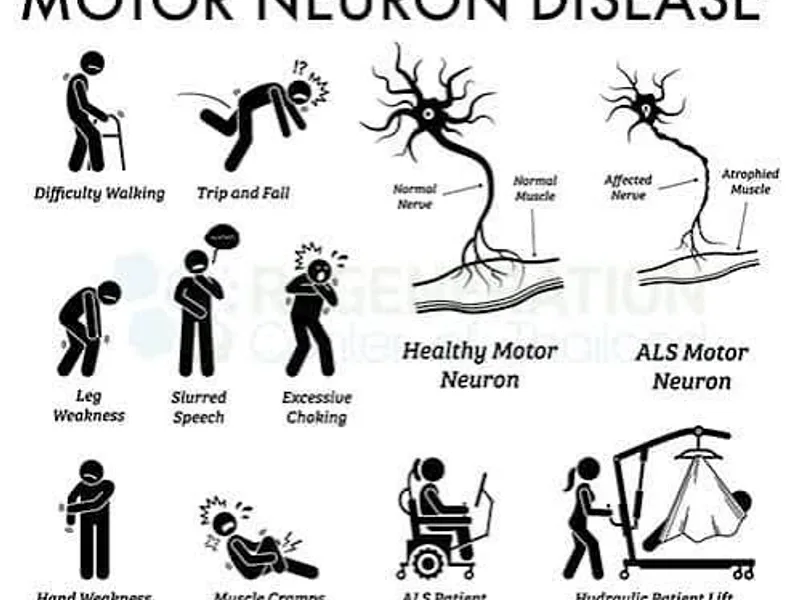
Unexplained muscle weakness in a hand, arm, or leg
Frequent tripping or dropping objects
Slurred speech or changes in voice
Muscle twitching (fasciculations) without pain
Unexplained fatigue during normal activities
Stiffness or cramping in muscles
Since these symptoms can overlap with other conditions, persistent or worsening symptoms should always be evaluated by a doctor.
Common Symptoms
As MND progresses, symptoms typically include:
Progressive muscle weakness, often starting in one limb
Muscle wasting (visible shrinking of muscle tissue)
Stiffness and spasms (spasticity)
Difficulty speaking (dysarthria) or swallowing (dysphagia)
Shortness of breath, especially when lying down
Unintentional weight loss
Emotional changes, including sudden laughing or crying (pseudobulbar affect)
In most types of MND, the senses, bladder/bowel control, and cognitive function remain relatively preserved, especially in early stages, though some patients may develop mild cognitive changes later.
Stages of the Disease
MND progression varies widely between individuals, but generally follows these stages:
Early Stage: Mild weakness in one area, such as a hand or foot. Daily activities are mostly manageable with minor adjustments.
Middle Stage: Weakness spreads to other muscle groups. Walking, speaking, and swallowing become noticeably harder. Mobility aids and assistive devices often become necessary.
Advanced Stage: Significant loss of muscle function across the body. Breathing muscles weaken, requiring respiratory support. The person becomes dependent on caregivers for most or all daily activities.
The speed of progression varies greatly — some people live for many years with slow progression, while others experience faster decline.
How Doctors Diagnose the Condition
There is no single test that confirms Motor Neuron Disease. Diagnosis is based on a combination of clinical evaluation and tests that rule out other conditions. A Neurologist plays a central role in this process.
Common diagnostic steps include:
Detailed medical history and physical examination – Checking reflexes, muscle strength, and coordination.
Electromyography (EMG) – Measures electrical activity in muscles to detect nerve damage.
Nerve conduction studies – Assess how well nerves transmit signals.
MRI scans – Used to rule out other causes such as spinal cord compression or tumors.
Blood and urine tests – To exclude other conditions with similar symptoms.
Genetic testing – Recommended if there's a family history of MND.
Because symptoms can mimic other neurological conditions, diagnosis sometimes takes time and may require monitoring over several months.
Available Treatment Options
While there is currently no cure for Motor Neuron Disease, treatments focus on slowing progression, managing symptoms, and maintaining quality of life for as long as possible.
Medications
Riluzole – The main medication shown to modestly slow disease progression in ALS.
Muscle relaxants – Help reduce stiffness and spasticity.
Medications for excess saliva – Manage drooling caused by swallowing difficulties.
Antidepressants – May help with mood changes and emotional lability.
Pain relief medications – Used as needed for muscle cramps and discomfort.
Therapies
Physiotherapy – Helps maintain mobility, reduce stiffness, and prevent joint problems.
Occupational therapy – Provides tools and techniques for daily tasks as strength declines.
Speech and language therapy – Supports communication and helps manage swallowing difficulties.
Nutritional support – A dietitian can help maintain healthy weight, and in advanced cases, a feeding tube may be recommended, often placed via Endoscopy, to ensure adequate nutrition.
Respiratory support – Breathing exercises and devices like non-invasive ventilation help support weakened breathing muscles, often managed in coordination with a Pulmonologist.
Lifestyle Management
Pacing activities to conserve energy
Using mobility aids such as walkers or wheelchairs as needed
Adapting the home for safety and accessibility
Maintaining good nutrition with softer foods if swallowing is difficult
Staying connected with support groups and counseling services
Daily Living Tips for Patients
Plan daily activities around energy levels, resting when needed
Use assistive devices like grab bars, raised toilet seats, and shower chairs
Keep frequently used items within easy reach to reduce strain
Practice breathing exercises recommended by your therapy team
Eat smaller, more frequent meals if swallowing is difficult
Stay engaged with hobbies and social activities adapted to current abilities
Complications if Left Untreated
Without proper medical care and support, MND can lead to serious complications, including:
Severe malnutrition and dehydration due to swallowing difficulties
Aspiration pneumonia from food or liquid entering the airway
Respiratory failure due to weakened breathing muscles
Pressure sores from immobility
Depression and social isolation
Rapid loss of independence
Timely intervention with appropriate therapies and equipment can significantly reduce these risks and improve comfort.
Prevention and Risk Reduction
Since the exact cause of most MND cases is unknown, there is no guaranteed way to prevent it. However, some general measures may support overall nerve health:
Maintaining a healthy, balanced diet rich in antioxidants
Avoiding exposure to known environmental toxins where possible
Managing chronic health conditions like diabetes and high blood pressure
Seeking genetic counseling if there is a family history of MND
Getting prompt medical attention for any unexplained, persistent muscle weakness
Early diagnosis, even though it cannot prevent MND, allows for earlier symptom management and better planning for care, often best coordinated through a Best Hospital for Motor Neuron Disease care team.
Frequently Asked Questions (FAQs)
1. Is Motor Neuron Disease the same as ALS? ALS is the most common type of Motor Neuron Disease, but MND also includes other related conditions.
2. Is MND hereditary? Most cases are not inherited, but about 5–10% have a genetic link, especially when there's a family history.
3. Can MND affect memory or thinking? In most cases, thinking and memory remain unaffected, though some patients may develop mild cognitive changes over time.
4. Is there a cure for MND? Currently, there is no cure, but treatments can help slow progression and manage symptoms.
5. How fast does MND progress? Progression varies widely — some people decline over a few years, while others progress more slowly over many years.
6. What is the first sign of MND usually? Often, the first sign is weakness in one hand, arm, or leg, or changes in speech.
7. Can physiotherapy help with MND? Yes, physiotherapy helps maintain mobility, reduce stiffness, and improve overall comfort.
8. Do all patients eventually need a feeding tube? Not all patients, but it's commonly considered when swallowing becomes significantly difficult to maintain nutrition.
9. Which specialist should I see first for suspected MND? A Neurologist is the right specialist to evaluate symptoms and begin the diagnostic process.
10. How can caregivers support someone with MND? Caregivers can help with daily tasks, emotional support, attending therapy sessions, and connecting with support groups for guidance.
Conclusion
Motor Neuron Disease is a serious condition that gradually affects muscle strength and function, impacting movement, speech, swallowing, and breathing. While there is no cure, a combination of medications, therapies, and lifestyle adjustments can help manage symptoms and maintain quality of life for as long as possible. Early diagnosis through a qualified neurologist, along with a strong support network of therapists, caregivers, and support groups, can make a meaningful difference in living well with MND. If you notice persistent muscle weakness or related symptoms, don't delay seeking medical evaluation.