The Importance of Skin Health Examinations
Malignant skin growths represent India's most prevalent form of the disease. Prompt identification of these conditions markedly enhances the likelihood of successful treatment.
Individuals frequently postpone medical evaluations, a delay that can complicate disease management. Consistent skin assessments constitute a crucial measure for preserving dermal well-being.
Understanding Dermal Malignancies
Dermal malignancies, or skin cancers, arise from the atypical proliferation of skin cells. Such conditions commonly result from exposure to ultraviolet (UV) radiation, whether from solar sources or artificial tanning devices. Indeed, extended periods of sun exposure represent a primary risk factor for all categories of these skin afflictions.
Categories of Skin Malignancies
Basal Cell Carcinoma (BCC): This represents the most frequent type, with BCCs typically emerging on sun-exposed regions such as the face and neck. Their growth is slow, and metastasis is uncommon.
Squamous Cell Carcinoma (SCC): These lesions also manifest on sun-exposed integument. Untreated, they demonstrate a greater propensity for dissemination compared to BCCs.
Melanoma: Although less prevalent, this form carries greater danger. Melanoma originates from melanocytes—specialized cells responsible for producing pigment—and possesses an elevated capacity to metastasize to other bodily systems.
Identifying Candidates for Skin Examinations
Although vigilance regarding skin health is beneficial for all, specific populations encounter elevated risks. This group comprises individuals who possess:
A background of substantial sun exposure or severe sunburn incidents.
Light complexion, fair hair, and blue or green irises.
Numerous pigmented lesions or atypical growths, known as dysplastic nevi.
A personal or familial antecedent of dermal malignancy.
A compromised immune system.
Practically speaking, for those who dedicate significant periods to outdoor activities, whether vocational or recreational, consistent dermal evaluations are indispensable.
The Procedure for a Dermal Assessment
A professional skin examination is a direct process. During this assessment, a dermatologist or a qualified medical practitioner thoroughly inspects the integumentary system from the cranium to the feet.
The objective is to identify any suspicious pigmented lesions, abnormal growths, or alterations. This comprehensive inspection encompasses areas such as the scalp, the interdigital spaces of the feet, and beneath the fingernails and toenenails.
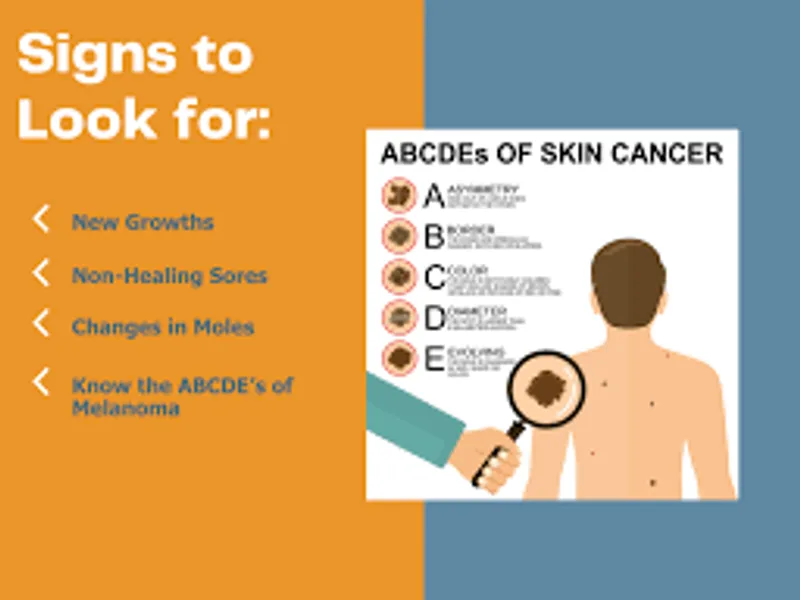
Recognizing Melanoma: The ABCDE Guide
Medical professionals employ the ABCDE guideline to detect potentially malignant skin lesions:
Asymmetry: One side of the lesion fails to mirror the other.
Border: The edges are uneven, notched, or indistinctly demarcated.
Color: Multiple hues are present within the same growth (e.g., variations of tan, brown, black, or even white/red).
Diameter: The lesion measures greater than 6mm (approximately the size of a standard pencil eraser), although smaller melanomas are possible.
Evolving: Any alteration in dimension, configuration, pigmentation, or height; or the onset of new manifestations such as hemorrhage, pruritus (itching), or excoriation (crusting).
It is important to note: Even lesions that do not strictly adhere to all these criteria may warrant attention. Always communicate any observed alterations to a healthcare provider.
The Value of Personal Skin Vigilance
Performing monthly self-assessments of your skin is crucial. This practice enables individuals to become familiar with their integument and identify alterations without delay. Consider this akin to routinely inspecting one's residence for any atypical indicators.
Here's where it gets interesting.
Familiarize yourself with your usual pigmented spots and freckles. Any novel or evolving feature should be reported to your physician without hesitation.
Indications for Professional Medical Consultation
Should an individual observe a novel lesion, an evolving pigmented growth, or a persistent ulceration, consultation with a medical professional is advised. Deferring this consultation until a subsequent scheduled examination is not recommended. The fundamental principle is clear: timely intervention can substantially influence prognosis.
Strategies for Preventing Dermal Malignancy
Prophylaxis continues to be the most effective safeguard. Minimizing exposure to ultraviolet (UV) radiation is paramount.
It is recommended to apply broad-spectrum sunscreen daily, don protective apparel, and find shade during periods of maximal solar intensity (10:00 to 16:00). Research published in The Lancet in 2023 indicated that regular application of sunscreen substantially diminishes the likelihood of acquiring skin-related malignancies.
Patient Narrative: A Case of Timely Intervention
Ramesh, an agricultural worker from Punjab, observed a small, darkened lesion on his arm that exhibited changes. He initially disregarded it, assuming it to be merely a sun-induced mark. Enduring such ambiguity can be considerably challenging. Fortunately, his spouse persuaded him to consult a local medical doctor.
The physician diagnosed it as a melanoma in its initial phase. Swift surgical excision ensured Ramesh's complete recuperation. His personal account underscores the critical importance of attentiveness.
That alone changes everything.
Professional Recommendations
According to directives issued by the Indian Association of Dermatologists, Venereologists and Leprologists (IADVL), consistent dermatological assessments are advised, particularly for individuals identified as high-danger. A prompt diagnosis, typically achieved via visual examination and occasionally confirmed by biopsy, facilitates opportune therapeutic action.
This methodology has demonstrated a profound improvement in patient survival rates.
Common Inquiries
What is the recommended frequency for professional skin examinations?
The appropriate interval for these evaluations is contingent upon an individual's specific danger factors. Typically, annual assessments are suggested for those at elevated danger. Your dermatologist will determine the most suitable schedule for your particular circumstances.
Is self-examination for skin lesions an powerful practice?
Indeed, conducting monthly self-assessments is fundamental. While these serve as a valuable complement to professional dermatological evaluations, they are not a substitute. Understanding the normal characteristics of your skin facilitates the rapid identification of worrisome alterations.
Does having darker skin negate the possibility of dermal malignancy?
No, individuals across the entire spectrum of skin tones are susceptible to developing skin malignancies. Although those with lighter complexions face an elevated probability, these conditions can manifest in individuals with darker skin, frequently appearing in regions not typically exposed to the sun, such as the palms or soles of the feet.
Recovery is rarely linear.
Prompt identification remains critical for all.
Is a skin biopsy a painful procedure?
A skin biopsy constitutes a minor medical intervention. Local anesthetic agents are routinely administered to desensitize the region, thereby mitigating discomfort. The majority of patients report experiencing minimal or no pain during the procedure itself.
Medically reviewed by a qualified physician. Last updated April 2025. For informational purposes only.