

Emergency & Help
24/7 Emergency & General Advisory
🚨 24/7 Medical Emergency
Non-Emergency Advisory
10:00 AM – 6:00 PM, Mon–Sat
For appointments & general queries.
24/7 Emergency & General Advisory
🚨 24/7 Medical Emergency
Non-Emergency Advisory
10:00 AM – 6:00 PM, Mon–Sat
For appointments & general queries.
Stay updated with our latest healthcare news and your appointments.
Cognitive Behavioural Therapy has one of the strongest evidence bases in mental healthcare. While professional guidance is valuable, many core CBT techniques are designed to be practised independently — and their effectiveness in self-help formats is well-documented.
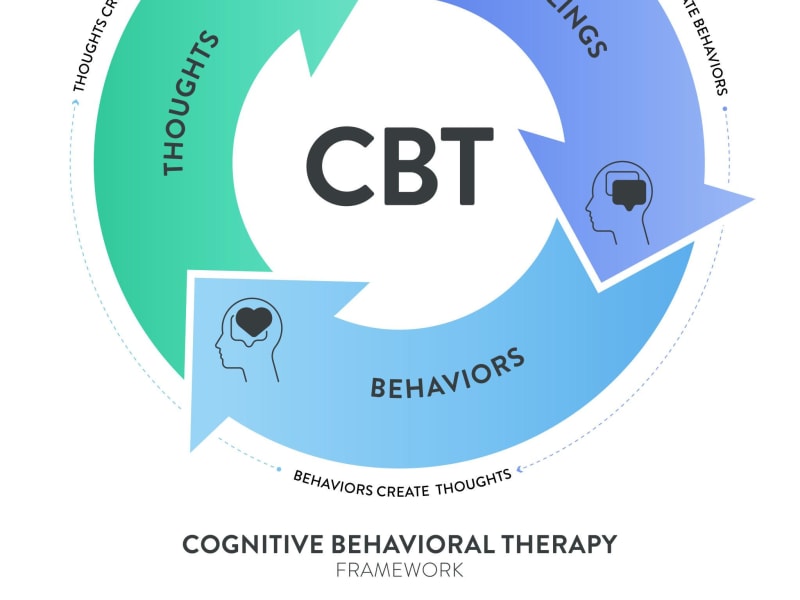
Cognitive Behavioural Therapy is the most evidence-based psychological treatment available. Here are practical CBT techniques you can use at home today.
Cognitive Behavioural Therapy (CBT) is among the most extensively researched and validated psychological interventions available, with robust evidence for effectiveness across depression, anxiety disorders, PTSD, insomnia, chronic pain, and eating disorders. Crucially, research consistently shows that guided self-help CBT — using structured techniques independently or with minimal therapist support — produces clinically meaningful improvements, particularly for mild to moderate presentations. These techniques aren't simplified versions of therapy; they're the actual tools trained therapists use.
CBT is built on the premise that thoughts, emotions, physical sensations, and behaviours are interconnected in a self-reinforcing cycle. Negative automatic thoughts (NATs) — rapid, habitual, often unconscious interpretations — trigger emotional distress and avoidant or safety behaviours, which in turn generate more negative thoughts. The entry point for change can be any part of this cycle, but CBT typically begins with cognition (thoughts) and behaviour.
This is the foundational CBT self-help tool. When you notice a significant negative emotion:
A – Activating event: Write down the situation that triggered the emotion
B – Beliefs/Thoughts: What thought went through your mind? (e.g., "Everyone thinks I'm incompetent")
C – Consequences: What emotions and behaviours followed?
Then challenge the thought by asking: What evidence supports this thought? What evidence contradicts it? What would I say to a friend thinking this? What is a more balanced interpretation? Write an alternative, realistic thought and rate the change in emotional intensity.
Used primarily for depression, behavioural activation breaks the inactivity-low mood cycle. Create a weekly activity schedule that includes both pleasurable activities (giving you positive reinforcement) and achievement-based tasks (restoring self-efficacy). Monitor mood before and after each activity. The goal is behavioural first — mood improvement follows action rather than preceding it.
Test your catastrophic predictions through structured action. If you believe "If I make a mistake at work, my colleagues will lose respect for me," design a small experiment that allows you to evaluate this belief against real-world data. Record the prediction, conduct the experiment, and record the actual outcome.
For generalised anxiety, this involves designating a fixed 15–20 minute daily "worry time" — when you intentionally examine and problem-solve your worries. When intrusive worries arise outside this time, note them briefly and deliberately postpone engagement until your scheduled slot. This trains attentional control and prevents worry from spreading through the day.
Defusion creates psychological distance from distressing thoughts. Rather than "I am a failure," practise reframing as "I'm having the thought that I'm a failure." This subtle shift — noting the thought as a mental event rather than an objective fact — reduces its emotional impact without requiring you to suppress or change the thought.
CBT techniques practised at home have genuine therapeutic value when applied consistently and self-reflectively. Begin with the thought record as your entry point — it teaches you to notice, examine, and reframe automatic negative thinking in a structured way. For more severe presentations, these tools work best as supplements to professional therapy rather than replacements. The most important step is simply beginning.
1. What is CBT in simple terms?
A therapy approach that helps change negative thoughts and behaviours to improve emotions.
2. Can CBT be practiced at home?
Yes, techniques like thought records and behavioural activation can be done independently.
3. Which CBT technique is best for beginners?
The thought record (ABC method) is the easiest and most effective starting point.
Author: Doctar Team
Disclaimer: For more information contact Doctar Team
Visit Hospital
Near You
Access expert medical advice in Kamarhati via online doctor consultations. Learn about benefits, how to choose a platform, and what to expect.
May 20, 2026
Expert advice for Joynagar residents on achieving stable blood sugar levels. Learn diet, exercise, and lifestyle tips for better diabetes management.
May 19, 2026
Explore breast cancer treatment options in Pujali, understanding diagnostics, therapies, and support for patients. Find expert care near you.
May 19, 2026