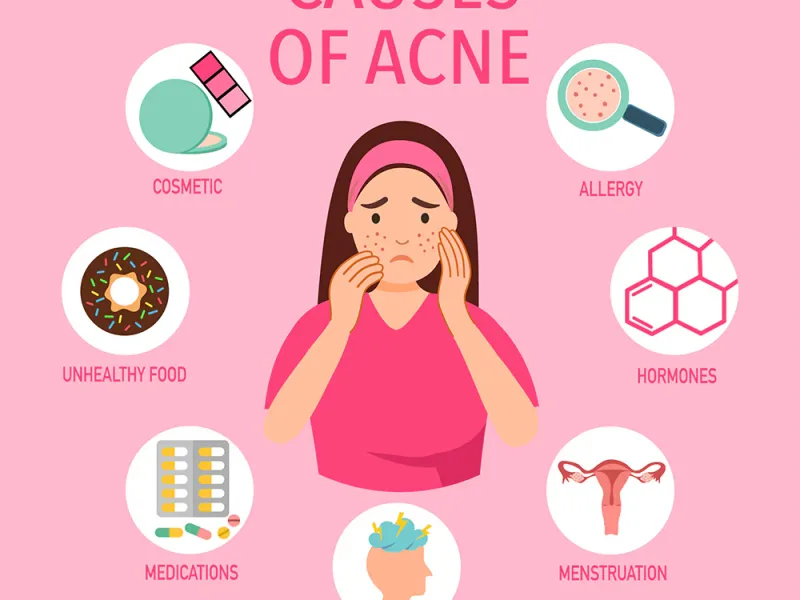
Acne develops from four factors working together inside the hair follicle: excess oil production, hair follicles clogged by oil and dead skin cells, bacterial growth, and inflammation, according to Mayo Clinic. No single cause is responsible on its own — it is the interaction between these four processes that determines how severe acne becomes and where it appears on the body.
Understanding acne starts at the hair follicle. Sebum — an oily substance the skin produces to lubricate hair and skin — combines with dead skin cells to plug the follicle. When that plug forms, bacteria naturally present on the skin can multiply inside it, triggering the inflammation and infection that drives more severe lesions, according to Mayo Clinic.
What happens next depends on how the blocked follicle responds. If the follicle wall bulges outward beneath the skin surface, a whitehead forms. If the plug reaches the surface and oxidizes on contact with air, it darkens into a blackhead. Deeper blockages and inflammation produce the painful nodules and cyst-like lumps associated with severe acne. Acne appears most commonly on the face, forehead, chest, upper back, and shoulders — the areas where sebaceous glands are most concentrated, according to Mayo Clinic.
[REVIEWER: add clinical insight here — e.g., how you explain the oil-bacteria-inflammation cycle to patients who keep getting recurring acne despite consistent skincare, and what the most common misunderstanding is that you find yourself correcting at clinical visits]
Hormones: The Biggest Single Driver
Hormonal activity is the most consistent trigger behind acne. During puberty, levels of androgens — sex hormones present in both male and female adolescents — rise sharply. This causes the sebaceous glands to enlarge and produce significantly more sebum, which is the primary reason acne is so common in the teenage years, according to Mayo Clinic.
The hormonal connection does not end with adolescence. Hormonal changes in women during midlife can trigger new or worsening breakouts. Many women experience predictable acne flares in the week before menstruation, tied to natural progesterone and estrogen fluctuations across the cycle. Pregnancy is another hormonally driven trigger — increased hormone activity leads to increased oil production through the same mechanism.
Genetics: Why Some People Are Simply More Prone
Acne has a clear genetic component. If both parents had acne, their child is more likely to develop it too, according to Mayo Clinic. This does not mean acne is inevitable for anyone with a family history, but it does explain why some people break out despite careful skincare while others with less rigorous habits remain clear.
Family history is a useful piece of clinical context when evaluating acne that starts young, is severe, or does not respond well to standard first-line treatments. It is also relevant when advising parents about monitoring children proactively rather than waiting for significant breakouts to develop.
Medications That Cause or Worsen Acne
Several medication categories are established acne triggers. Drugs containing corticosteroids, testosterone, or lithium can cause or worsen acne, according to Mayo Clinic. Anyone who notices a new or worsening breakout pattern shortly after starting a new medication has good reason to mention it to their prescribing doctor — drug-induced acne is a distinct clinical entity that may require adjusting the medication rather than escalating acne treatment.
A sudden, severe breakout in an older adult deserves particular attention. Sudden-onset severe acne later in life can signal an underlying condition requiring medical evaluation, rather than a typical late-life flare, according to Mayo Clinic. This presentation is worth investigating rather than managing empirically with over-the-counter products.
Diet's Role: Real but Limited
Diet is one of the most contested areas in acne research, and popular claims significantly outrun the evidence. Some studies suggest that high-glycemic foods — white bread, chips, sugary drinks, bagels — may worsen existing acne in some people by elevating insulin levels, which in turn increases androgen production. That is a different and more modest claim than saying diet causes acne. The more accurate framing is that certain dietary patterns may amplify existing acne in predisposed individuals, not that food is a root cause, according to Mayo Clinic's clinical overview.
Chocolate and greasy food specifically have little to no established effect on acne, despite being among the most persistent popular beliefs about skin. The mechanism for diet's influence — if real — involves systemic insulin and androgen activity, not the oil from a particular food contacting the skin.
Physical Friction: A Trigger Often Missed
Repeated friction or pressure on the skin is a well-documented but underrecognized acne trigger. Items including phones held against the face, helmets, tight collars, chin straps, and backpack straps can produce localized breakouts wherever they consistently contact skin — sometimes called mechanical acne, according to Mayo Clinic.
This cause is worth flagging specifically for breakouts that consistently appear in one location: recurring jawline acne in someone who uses a phone a lot, forehead breakouts in athletes who wear headgear, or back acne along the line of a backpack. Identifying a mechanical trigger often opens a simple and effective avenue for improvement that systemic treatment would not address.
[REVIEWER: add clinical insight here — e.g., which lesser-known triggers — friction, medications, or specific dietary patterns — patients are most surprised to learn about at clinical visits, and how identifying these changes the management conversation]
Stress: A Modifier, Not a Root Cause
Stress occupies a specific and frequently misunderstood role in acne. Stress does not cause acne on its own, but if acne is already present, stress can make it worse, according to Mayo Clinic. The likely mechanism involves stress-induced increases in cortisol and androgen output, which amplify sebum production and inflammation in skin that is already prone to breaking out.
This distinction matters practically. Reducing stress is unlikely to prevent acne from developing in someone who has not had it before, but it may meaningfully reduce the frequency or severity of flares in someone who already has it. Framing stress as a trigger rather than a cause helps patients address it without unrealistic expectations.
Myths Worth Retiring
Several widely held beliefs about acne causation do not hold up against clinical evidence.
Chocolate and greasy food. Despite being the most commonly cited dietary culprits, neither chocolate nor greasy food has meaningful established evidence linking it to acne development, according to Mayo Clinic.
Poor hygiene. Acne is not caused by dirty skin. Scrubbing harder or using harsh soaps and strong chemicals irritates the skin barrier, disrupts the skin's natural protective environment, and can make acne worse rather than better, according to Mayo Clinic.
Cosmetics. Oil-free, noncomedogenic cosmetic products that are thoroughly removed at the end of the day do not worsen acne and do not interfere with acne medications, according to Mayo Clinic. The risk lies with heavy, oil-based products left on skin overnight, not with cosmetics as a category.
Why Understanding Real Causes Matters
Knowing what actually drives acne — rather than what popular wisdom suggests — directly affects what is worth changing. Scrubbing more aggressively, eliminating chocolate, or replacing all cosmetics will not address the four real mechanisms: excess oil, clogged pores, bacterial growth, and inflammation. In some cases those responses make things worse. Recognizing the genuine drivers — hormonal shifts, genetic predisposition, specific medications, friction — gives a more accurate starting point for targeted management, whether that is over-the-counter care, a lifestyle change, or a conversation with a clinician.
FAQ
What is the main cause of acne? Acne results from four interacting factors: excess oil production, clogged hair follicles, bacterial growth, and inflammation — with hormonal changes, particularly increased androgen levels, as the most consistent driver behind these processes. No single cause is responsible on its own; it is the combination that determines severity.
Does poor hygiene cause acne? No. Acne is not caused by dirty skin, and scrubbing harder or using harsh soaps can irritate the skin and make breakouts worse. The underlying cause is inside the pore — excess oil, clogged follicles, and bacteria — not surface dirt. Gentle cleansing twice daily is generally recommended, not aggressive scrubbing.
Can stress cause acne? Not directly. Stress does not trigger new acne on its own, but it can worsen existing acne by increasing cortisol and androgen output, which raises oil production and inflammation. Managing stress may help reduce the severity or frequency of flares without necessarily preventing acne from developing in the first place.
Does diet actually cause acne? Diet is not considered a primary cause of acne. Some research links high-glycemic foods — white bread, chips, sugary drinks — to worsening existing acne in certain people through insulin-androgen pathways. Chocolate and greasy foods specifically have little established effect. Dietary changes alone are unlikely to resolve acne, but may help reduce flares in people who notice a clear dietary pattern.
Why do I get acne in the same spot every time? Recurring acne in one consistent location often points to a specific local trigger rather than a general hormonal or internal cause. Repeated friction from a phone held against the face, a helmet, tight collar, chin strap, or headband — sometimes called mechanical acne — can produce localized breakouts that persist as long as the friction source remains. Identifying and removing the mechanical trigger can resolve these breakouts more effectively than adjusting skincare alone.