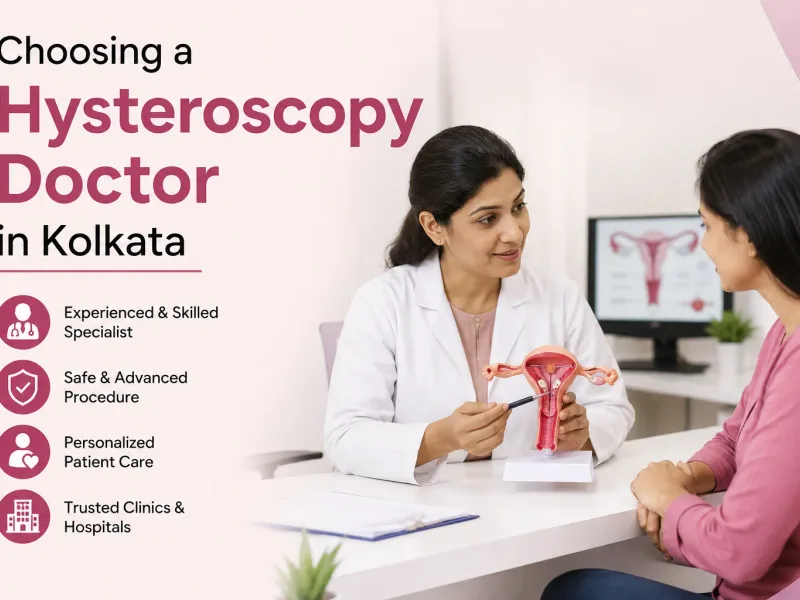
Hysteroscopy is a procedure in which a gynecologist inserts a thin, lighted instrument called a hysteroscope through the vagina and cervix to examine the inside of the uterus directly. It's used both to diagnose problems like abnormal bleeding, polyps, and fibroids, and — in the same sitting — to treat many of them. For women in Kolkata weighing this procedure, the more urgent question is usually not "what is hysteroscopy" but "which doctor should I trust with it."
[REVIEWER: add clinical insight here — for example, common presenting complaints you see in Kolkata patients before a hysteroscopy referral, or how case volume affects your comfort recommending outpatient vs. hospital-based procedures.]
During a diagnostic hysteroscopy, the doctor distends the uterine cavity — typically with saline — to get a clear view, then examines the lining for abnormalities. If something needs to be removed or corrected, such as a polyp, fibroid, or scar tissue, the same instrument can often be used to treat it in what's called an operative hysteroscopy, avoiding a separate surgery altogether. According to the American College of Obstetricians and Gynecologists (ACOG), hysteroscopy is a standard tool for diagnosing and treating intrauterine conditions and has largely replaced more invasive exploratory procedures for many indications.
Most patients tolerate the procedure well. Outpatient (office-based) hysteroscopy has become more common as instruments have gotten thinner and techniques less invasive, and many patients resume normal activity within a day. That said, it is still a medical procedure with real risks — including uterine perforation, infection, and, rarely, complications from the fluid used to distend the uterus — which is exactly why the choice of doctor matters.
Why the Doctor You Choose Matters More Than the Procedure Name
Hysteroscopy is officially considered minimally invasive and generally safe, but outcomes depend heavily on operator experience. Uterine perforation is the most commonly reported complication, and it's more likely during more complex resections that extend into the uterine wall. A hysteroscopy performed by a gynecologist who does the procedure regularly, in a hospital with proper anesthesia and imaging backup, carries a different risk profile than one performed occasionally with minimal infrastructure.
This is why "find a hysteroscopy doctor in Kolkata" is really a checklist question, not a search-engine question.
Credentials Worth Verifying
Qualification: Look for an MD or DGO in Obstetrics & Gynecology, ideally with additional fellowship training in gynecological endoscopy or minimally invasive surgery.
Registration: Confirm current registration with the West Bengal Medical Council or the National Medical Commission.
Case volume: Ask directly how many hysteroscopies the doctor performs annually — a low-volume practice isn't automatically unsafe, but it's a fair question.
Hospital affiliation: A doctor operating out of a hospital with anesthesia support, blood bank access, and imaging on-site is generally better positioned to manage complications if they arise.
[REVIEWER: add clinical insight here — for example, what you personally ask a colleague before referring a patient for hysteroscopy, or what you'd want a patient to know about diagnostic vs. operative hysteroscopy before consenting.]
Questions to Ask Before You Book
A good first consultation should leave you with clear answers to these questions, not vague reassurance:
Is this diagnostic, operative, or both — and will I know which during the pre-op discussion or only after?
What type of anesthesia is used, and is it done in an OT or an office setting?
What specifically is being investigated or treated in my case (polyp, fibroid, adhesions, abnormal bleeding, infertility workup)?
What are the realistic risks for someone with my specific history?
What does recovery look like, and when can I resume normal activity?
If a doctor is unwilling to walk through these plainly, that's worth noting.
What Hysteroscopy Is Commonly Used For
Abnormal uterine bleeding: to identify polyps, fibroids, or endometrial abnormalities causing heavy or irregular periods.
Infertility evaluation: to check for structural issues inside the uterine cavity that could affect implantation.
Uterine septum or adhesions: often found in recurrent pregnancy loss workups.
Polyp or fibroid removal: many can be removed in the same procedure used to diagnose them.
Not every abnormal bleeding case requires hysteroscopy immediately — ultrasound and hormonal evaluation often come first. A doctor who orders hysteroscopy as a first step without those preceding evaluations is worth a second opinion.
Red Flags When Choosing a Hysteroscopy Doctor
Pressure to schedule surgery on the same day as the first consultation, without diagnostic imaging first.
Vague or evasive answers about complication rates or what happens if something is found mid-procedure.
No clear explanation of anesthesia type or recovery timeline.
Reluctance to share hospital affiliation or registration details.
A Practical Takeaway
Hysteroscopy is a well-established, generally safe procedure — but "well-established" describes the technique, not any specific doctor. Before booking, confirm the doctor's gynecology qualification and endoscopy training, ask about case volume and hospital backup, and get a plain-language explanation of what's being investigated in your case specifically. A doctor who welcomes those questions is usually the right one to proceed with.
FAQ
Is hysteroscopy painful? Most patients describe cramping similar to menstrual pain rather than sharp pain, especially with outpatient techniques. Operative hysteroscopy under anesthesia is typically painless during the procedure, with mild cramping and spotting afterward.
How long does recovery take after hysteroscopy? Many patients resume normal activities within 24 hours for diagnostic hysteroscopy. Operative procedures may need a few days of rest, depending on what was treated and the anesthesia used.
Can hysteroscopy help with infertility? Yes — it can identify and often correct uterine cavity issues like polyps, adhesions, or a septum that may interfere with implantation. It's typically one part of a broader infertility workup, not a standalone fix.
Is hysteroscopy the same as laparoscopy? No. Hysteroscopy examines the inside of the uterus through the vagina and cervix, with no external incisions. Laparoscopy examines the outside of the uterus and pelvic organs through small abdominal incisions. They're sometimes done together.
What's the difference between diagnostic and operative hysteroscopy? Diagnostic hysteroscopy is purely for viewing and evaluating the uterine cavity. Operative hysteroscopy uses the same access to actively treat what's found — removing a polyp or fibroid, for instance — often in the same sitting.