

Emergency & Help
24/7 Emergency & General Advisory
🚨 24/7 Medical Emergency
Non-Emergency Advisory
10:00 AM – 6:00 PM, Mon–Sat
For appointments & general queries.
24/7 Emergency & General Advisory
🚨 24/7 Medical Emergency
Non-Emergency Advisory
10:00 AM – 6:00 PM, Mon–Sat
For appointments & general queries.
An ectopic pregnancy occurs when a fertilized egg implants outside the uterus — most often in a fallopian tube — and cannot develop normally. Left untreated, it can cause the tube to rupture and trigger life-threatening internal bleeding. Ectopic pregnancies account for 5% to 10% of all pregnancy-re
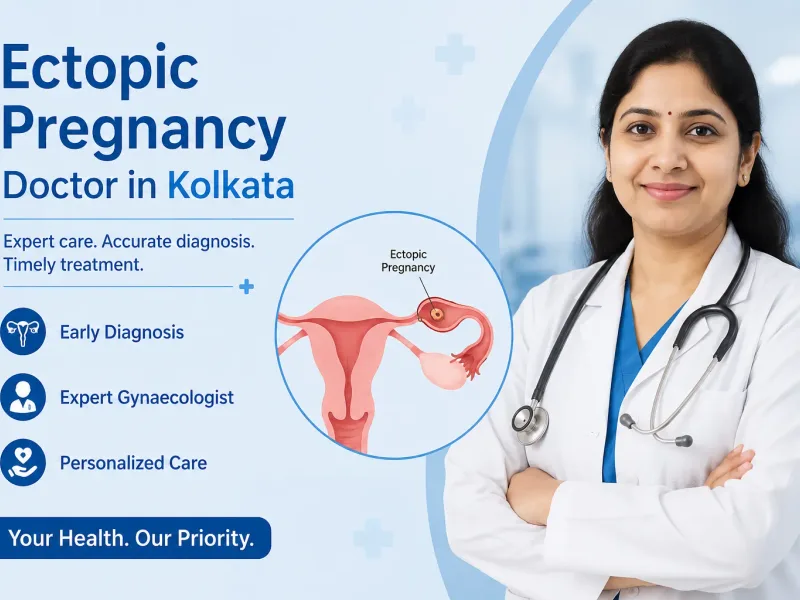
An ectopic pregnancy occurs when a fertilized egg implants and begins to grow outside the main cavity of the uterus — most commonly in a fallopian tube. It cannot develop into a viable pregnancy and, if not treated promptly, can cause the fallopian tube to rupture, leading to severe internal bleeding that is life-threatening. <cite index="39-1">Ectopic pregnancies are the leading cause of maternal mortality in the first trimester, with an incidence of 5% to 10% of all pregnancy-related deaths.</cite> Early diagnosis is the most critical factor in preventing serious complications.
A normal pregnancy begins when a fertilized egg travels down the fallopian tube and implants in the lining of the uterus. <cite index="36-1">An ectopic pregnancy occurs when a fertilized egg implants and grows outside the main cavity of the uterus. An ectopic pregnancy most often occurs in a fallopian tube — called a tubal pregnancy — though it can also occur in the ovary, abdominal cavity, or cervix.</cite>
The key medical reality is that <cite index="36-1">an ectopic pregnancy can't proceed normally. The fertilized egg can't survive, and the growing tissue may cause life-threatening bleeding if left untreated.</cite> There is no medical scenario in which an ectopic pregnancy can be transferred to the uterus and allowed to continue. Prompt treatment is always necessary.
Ectopic pregnancies occur in approximately 1 in 50 pregnancies in the United States, according to Johns Hopkins Medicine. In India, reported rates are lower but likely underestimated due to gaps in facility-based detection — particularly in cases that present to emergency rooms with rupture, where the initial diagnosis may not be recorded accurately.
Any person who can become pregnant is at some risk for ectopic pregnancy, but several factors significantly increase that risk. According to the Mayo Clinic and the NIH StatPearls review, these include:
Previous ectopic pregnancy — the single strongest risk factor; having one ectopic pregnancy substantially raises the chance of another
Inflammation or infection of the fallopian tubes — including pelvic inflammatory disease (PID), most often caused by sexually transmitted infections such as chlamydia or gonorrhea
Previous fallopian tube surgery, including tubal ligation (sterilization) or surgery to correct a blocked tube
Fertility treatments such as in vitro fertilization (IVF) — multiple embryo transfers increase the statistical chance of implantation outside the uterus
Endometriosis — scar tissue from this condition can partially block or narrow fallopian tubes
Smoking — associated with impaired tubal motility and increased ectopic risk in several studies
Pregnancy with an intrauterine device (IUD) in place — while IUDs are highly effective at preventing pregnancy, if conception does occur, the risk that the pregnancy is ectopic is higher
Age over 35 is also associated with increased risk, likely reflecting cumulative exposure to some of the above factors over time.
<cite index="36-1">Some women who have an ectopic pregnancy have the usual early signs or symptoms of pregnancy — a missed period, breast tenderness and nausea. If you take a pregnancy test, the result will be positive.</cite>
This is what makes ectopic pregnancy so dangerous: the early presentation is indistinguishable from a normal pregnancy. A woman may not seek care because everything seems normal. The first warning signs that something is wrong typically develop as the growing tissue stretches the fallopian tube.
<cite index="36-1">Often, the first warning signs of an ectopic pregnancy are light vaginal bleeding and pelvic pain. If blood leaks from the fallopian tube, you may feel shoulder pain or an urge to have a bowel movement.</cite>
The shoulder pain — called referred shoulder pain — occurs because blood pooling in the abdominal cavity irritates the diaphragm, which shares nerve pathways with the shoulder. It is often experienced as a dull, diffuse ache under the collarbone or at the shoulder tip. Its presence alongside pelvic pain and a positive pregnancy test should be treated as an emergency.
Symptoms that require immediate emergency care include:
Sudden, severe abdominal or pelvic pain
Heavy vaginal bleeding
Shoulder pain alongside other symptoms
Extreme dizziness, fainting, or low blood pressure — signs of internal bleeding and potential rupture
<cite index="39-1">Women presenting in the first trimester with abdominal pain and vaginal bleeding have an ectopic pregnancy prevalence in emergency departments as high as 18%</cite> — a figure that underscores why these symptoms should never be attributed to a minor cause without investigation.
[REVIEWER: add clinical insight here — e.g., how a gynecologist or emergency physician differentiates ectopic pregnancy from other first-trimester conditions presenting with similar symptoms — including appendicitis, threatened miscarriage, and ovarian cyst rupture — and what clinical examination findings most reliably raise suspicion]
No physical examination alone can diagnose an ectopic pregnancy. The diagnostic process combines blood tests and imaging.
<cite index="40-1">Your doctor will order the human chorionic gonadotropin (HCG) blood test to confirm that you're pregnant. This blood test may be repeated every few days until ultrasound testing can confirm or rule out an ectopic pregnancy — usually about five to six weeks after conception.</cite>
In a normal pregnancy, beta-hCG levels roughly double every 48 hours. In an ectopic pregnancy, levels often rise more slowly or plateau. Serial testing — measuring hCG multiple times over several days — helps identify this abnormal pattern and guides the urgency of further investigation.
<cite index="40-1">A transvaginal ultrasound allows your doctor to see the exact location of your pregnancy. A wandlike device is placed into your vagina, using sound waves to create images of your uterus, ovaries, and fallopian tubes.</cite>
Transvaginal ultrasound is the most important diagnostic tool. In most cases, it can confirm whether the gestational sac (the early structure of pregnancy) is inside or outside the uterus. In very early pregnancy, however — before six weeks of gestation — neither the uterine cavity nor the ectopic location may yet be visible.
<cite index="39-1">The current standard for ectopic pregnancy diagnosis includes ultrasound imaging and β-hCG monitoring combined, as diagnosis of ectopic pregnancies is difficult due to clinical mimics and non-specific symptoms.</cite>
When imaging and hCG trends do not give a definitive answer, the condition is classified as a "pregnancy of unknown location" — a clinical holding state that requires close monitoring until the situation clarifies.
<cite index="41-1">If the ectopic pregnancy is diagnosed early, the patient remains hemodynamically stable, and the affected fallopian tube is intact, treatment options include medical management with intramuscular methotrexate or surgical options such as salpingostomy (removal of the ectopic pregnancy while preserving the fallopian tube) or salpingectomy (removal of part or all of the affected fallopian tube).</cite>
<cite index="38-1">An early ectopic pregnancy without unstable bleeding is most often treated with a medication called methotrexate, which stops cell growth and dissolves existing cells. The medication is given by injection. After the injection, your doctor will order another hCG test to determine how well treatment is working and if you need more medication.</cite>
Methotrexate is effective when the ectopic pregnancy is detected early — when hCG levels are below a certain threshold, the tube has not ruptured, and the patient is clinically stable. It avoids surgery and, in many cases, preserves the fallopian tube, which matters for future fertility. The patient requires close follow-up for several weeks while hCG levels are monitored.
When the tube has ruptured, or when medical management is not appropriate, surgery is required. <cite index="38-1">If the ectopic pregnancy is causing heavy bleeding, emergency surgery may be needed. This can be done laparoscopically (through small incisions with a camera) or, if the situation is critical, as open abdominal surgery.</cite>
Laparoscopic surgery is the standard approach when the patient is stable enough for a planned procedure. In salpingostomy, the ectopic tissue is removed and the tube preserved; in salpingectomy, the tube is removed. The choice depends on the degree of damage, the patient's overall reproductive status, and their plans for future pregnancies.
[REVIEWER: add clinical insight here — e.g., from a gynecologist's perspective, what factors determine the choice between methotrexate and surgery in clinical practice in India — including hCG thresholds, availability of follow-up monitoring, and how a ruptured presentation changes the decision entirely]
A concern for many patients is what ectopic pregnancy means for future pregnancies. The answer depends on which treatment was used and whether both tubes remain functional.
With one tube removed, conception is still possible — the remaining tube can capture eggs released from either ovary. Studies show that many patients go on to have successful intrauterine pregnancies, though the risk of a second ectopic pregnancy is elevated. Patients who have had one ectopic pregnancy should have early ultrasound confirmation of the location of any future pregnancy, ideally at 6 to 7 weeks of gestation.
A gynecologist can advise on the appropriate timing to attempt conception again after treatment and what monitoring will be needed in a future pregnancy.
If you are pregnant — or think you might be — and develop sudden severe pelvic pain, heavy vaginal bleeding, shoulder pain, or dizziness, go to the nearest emergency department immediately. Do not wait to see if symptoms improve.
In Kolkata, facilities with 24-hour gynecological emergency services include AMRI Hospitals, Apollo Multispeciality Hospitals, Fortis Hospital, the Institute of Post Graduate Medical Education and Research (IPGMER), and Seth Sukhlal Karnani Memorial (SSKM) Hospital. A gynecologist with experience in emergency obstetric care can confirm the diagnosis and guide you through treatment options.
What are the first signs of an ectopic pregnancy? The earliest signs are often identical to a normal pregnancy: a missed period, positive pregnancy test, nausea, and breast tenderness. As the ectopic tissue grows, warning signs emerge — typically light vaginal bleeding, one-sided pelvic or abdominal pain, and sometimes shoulder pain or the urge to have a bowel movement. Sudden severe pain is a medical emergency, according to the Mayo Clinic.
Can an ectopic pregnancy be saved or moved to the uterus? No. There is no medical procedure that can transfer an ectopic pregnancy to the uterus and allow it to continue. The ectopic tissue cannot develop into a viable pregnancy and must be treated — either with medication (methotrexate) to stop cell growth or with surgery to remove it. Treatment is necessary to prevent life-threatening rupture and internal bleeding.
Does treatment for ectopic pregnancy affect future fertility? It depends on the treatment. Methotrexate, if used early, often preserves the fallopian tube. Laparoscopic removal of the ectopic pregnancy while preserving the tube (salpingostomy) may also maintain fertility. If the tube is removed (salpingectomy), the remaining tube can still support conception. Most patients who have had one ectopic pregnancy can go on to have a normal intrauterine pregnancy, though early ultrasound is recommended in any subsequent pregnancy.
How is an ectopic pregnancy diagnosed? Diagnosis requires two things: a blood test measuring beta-hCG (the pregnancy hormone) and a transvaginal ultrasound to identify the location of the gestational sac. In very early pregnancy, neither test alone may be conclusive, and serial hCG measurements over several days may be needed to track the pattern of hormone rise, according to the Mayo Clinic and NIH StatPearls.
What are the risk factors for ectopic pregnancy? Key risk factors include a previous ectopic pregnancy, a history of pelvic inflammatory disease (PID) caused by sexually transmitted infection, prior fallopian tube surgery or sterilization, fertility treatments such as IVF, endometriosis, and smoking. Women with any of these factors should inform their doctor at the beginning of any pregnancy so early confirmatory ultrasound can be arranged.
Visit Hospital
Near You

A cesarean section (C-section) is a surgical delivery in which a baby is born through an incision in the mother's abdomen and uterus. In Kolkata, several experienced obstetricians and well-equipped hospitals offer C-section services for planned and emergency deliveries. Understanding when a C-sectio
July 31, 2026
If you are searching for a Menstrual Disorders in Adolescent Girls Doctor in Kolkata, early evaluation by an experienced gynecologist can help identify the underlying cause of irregular or painful periods. While menstrual irregularities are common during the first few years after puberty, persistent
July 31, 2026

If you are searching for a Fibroid & Endometriosis doctor in Kolkata, choosing an experienced gynecologist with expertise in minimally invasive gynecological surgery is essential. Uterine fibroids and endometriosis are two common but different conditions that can cause pelvic pain, heavy menstrual b
July 31, 2026