Ectopic Pregnancy: Symptoms, Treatment, and Care in Kolkata
An ectopic pregnancy occurs when a fertilized egg implants and grows outside the main cavity of the uterus — most commonly in a fallopian tube. It is a medical emergency: an ectopic pregnancy cannot survive to term, and as it grows, it can cause the fallopian tube to rupture and trigger life-threatening internal bleeding. Ectopic pregnancy accounts for approximately 1–2% of all pregnancies and remains one of the leading causes of maternal death in the first trimester, according to clinical research published in PMC and guidance from the American College of Obstetricians and Gynecologists (ACOG).
In a normal pregnancy, a fertilized egg travels through the fallopian tube and implants in the uterus, where it develops into a baby. In an ectopic pregnancy, the egg implants elsewhere — and there is no space or blood supply outside the uterus that can support a growing pregnancy.
About 95% of ectopic pregnancies occur in the fallopian tubes, which is why they are often called tubal pregnancies. Less commonly, implantation occurs in the ovary, the cervix, or — increasingly, as caesarean section rates rise — in the scar tissue from a prior C-section. Each location carries its own risks and management considerations.
A key fact that many women do not know: a positive home pregnancy test does not distinguish between a normal and an ectopic pregnancy. The hormone hCG (human chorionic gonadotropin), which home tests detect, is produced in both. This is why early confirmation of a pregnancy's location — particularly for women with any risk factors — is so important.
Warning Signs: Symptoms of Ectopic Pregnancy
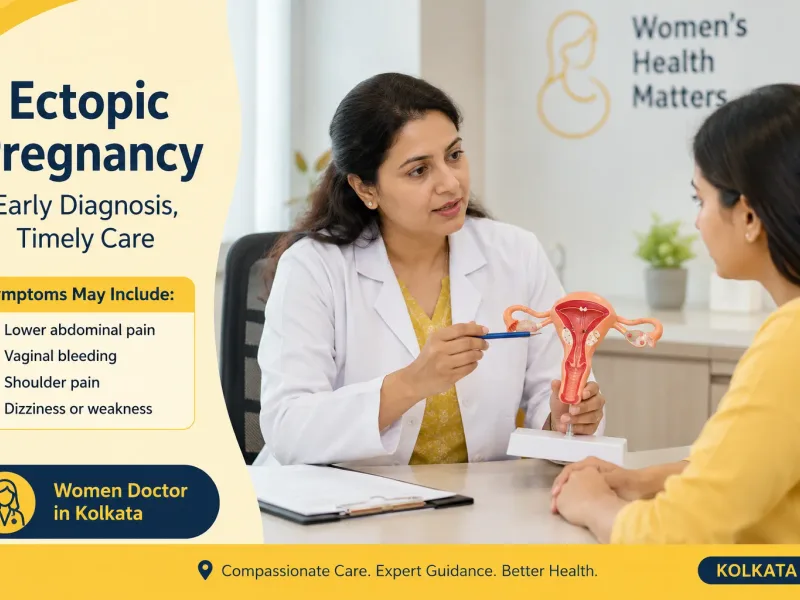
Ectopic pregnancies often begin without any symptoms, which makes early diagnosis challenging. As the pregnancy grows, symptoms typically appear between weeks 4 and 12 after the last menstrual period. <cite index="36-1">Often, the first warning signs of an ectopic pregnancy are light vaginal bleeding and pelvic pain. If blood leaks from the fallopian tube, a woman may feel shoulder pain or an urge to have a bowel movement.</cite>
The full range of symptoms includes:
Missed period — combined with a positive pregnancy test
One-sided pelvic or abdominal pain — often sharp or cramping, on the side where the ectopic pregnancy is located
Vaginal bleeding — usually lighter than a normal period, sometimes described as spotting
Shoulder tip pain — caused by blood tracking up to the diaphragm and irritating the phrenic nerve; an important and underrecognized warning sign
Nausea, vomiting, and breast tenderness — early pregnancy symptoms that may be present regardless of location
A prospective Indian study published in PMC found that amenorrhea (missed periods) was the most common presenting symptom, seen in 97.33% of ectopic pregnancy cases, with abdominal pain and vaginal bleeding appearing in the majority of cases as well.
When to Call for Emergency Help
<cite index="36-1">If the fertilized egg continues to grow in the fallopian tube, it can cause the tube to rupture. Heavy bleeding inside the abdomen is likely. Symptoms of this life-threatening event include extreme lightheadedness, fainting and shock.</cite>
Go to an emergency department immediately if you have a positive pregnancy test and develop sudden severe abdominal or pelvic pain, heavy bleeding, shoulder tip pain, or feel faint or lose consciousness. Tubal rupture can cause death within hours without surgical intervention.
[REVIEWER: add clinical insight here — e.g., from a gynecologist's experience, how to distinguish ectopic pain from other causes of acute pelvic pain in women of reproductive age, and the specific scenarios in which clinical suspicion should be elevated even before ultrasound confirms a diagnosis]
Risk Factors: Who Is More Likely to Have an Ectopic Pregnancy?
Any woman who can become pregnant can have an ectopic pregnancy. However, certain factors significantly raise the risk, according to ACOG, Mayo Clinic, and peer-reviewed Indian obstetric literature:
Previous ectopic pregnancy — the strongest single risk factor; having one ectopic pregnancy raises the risk of a subsequent one
Previous fallopian tube surgery — including surgery to treat a prior ectopic pregnancy or to reverse a tubal ligation
Pelvic inflammatory disease (PID) — infection of the uterus, fallopian tubes, and surrounding pelvic organs, often caused by sexually transmitted infections, which can cause scarring that blocks or damages the tubes
Prior abdominal or pelvic surgery — any procedure that could lead to scar tissue formation around the fallopian tubes
Endometriosis — a condition in which tissue similar to the uterine lining grows outside the uterus, which can alter normal tubal anatomy
Infertility or fertility treatments — particularly in vitro fertilization (IVF), which slightly increases ectopic risk
Smoking — associated with delayed egg transport through the fallopian tube
Intrauterine device (IUD) use — IUDs are highly effective at preventing intrauterine pregnancy, but if pregnancy occurs despite an IUD, there is a higher likelihood it will be ectopic
In the Indian context, a 2024–2025 hospital-based cross-sectional study at a tertiary care center in India found a frequency of ectopic pregnancy of 5.55% among women attending the gynecology department — somewhat higher than the global estimate of 1–2%, reflecting the burden of pelvic infections and prior surgery in the study population.
Diagnosis: How Is an Ectopic Pregnancy Identified?
Ectopic pregnancy is diagnosed using a combination of three tools, according to Mayo Clinic and the NICE guidelines (2023 update):
1. Serum beta-hCG (blood test). The pregnancy hormone hCG is measured and, critically, tracked over time. In a normal intrauterine pregnancy, hCG levels roughly double every 48–72 hours. In an ectopic pregnancy, levels typically rise more slowly or plateau abnormally. A single hCG value cannot diagnose an ectopic pregnancy — serial measurements are more informative.
2. Transvaginal ultrasound (TVS). This is the most important diagnostic tool. A transvaginal ultrasound can visualize the uterus and adnexal (tube and ovary) regions. If no gestational sac is seen inside the uterus in a woman with a positive pregnancy test and an hCG level above approximately 1,500–2,000 mIU/mL, ectopic pregnancy is strongly suspected. A visible adnexal mass or gestational sac outside the uterus confirms it.
3. Clinical assessment. A pelvic examination can identify pain, tenderness, or a mass. However, Mayo Clinic notes that physical examination alone cannot diagnose ectopic pregnancy — imaging and blood tests are required.
Treatment Options
Treatment depends on the gestational age, the woman's stability, and the location and size of the ectopic pregnancy. There are three main approaches:
Medical Treatment: Methotrexate
<cite index="42-1">An early ectopic pregnancy without unstable bleeding is most often treated with a medication called methotrexate, which stops cell growth and dissolves existing cells. The medication is given by injection. It's very important that the diagnosis of ectopic pregnancy is certain before receiving this treatment.</cite>
After the injection, serial hCG levels are monitored to confirm that the pregnancy tissue is resolving. Some women require more than one dose. Methotrexate preserves the fallopian tube and is preferred when the ectopic pregnancy is small, the tube has not ruptured, and the woman is hemodynamically stable. However, it has contraindications including breastfeeding, immunosuppression, certain liver or kidney conditions, and elevated baseline hCG levels above a certain threshold.
Surgical Treatment: Laparoscopy
<cite index="42-1">Salpingostomy and salpingectomy are two laparoscopic surgeries used to treat some ectopic pregnancies. In these procedures, a small incision is made in the abdomen, near or in the navel. A thin tube equipped with a camera lens and light is used to view the tubal area.</cite>
Salpingostomy removes the ectopic pregnancy while leaving the tube in place. Salpingectomy removes part or all of the affected tube. The choice between them depends on the extent of tubal damage, the condition of the other tube, and the woman's desire for future fertility.
Emergency Surgery
When the fallopian tube has already ruptured — signaled by severe pain, internal bleeding, and hemodynamic instability — emergency open abdominal surgery (laparotomy) may be required to control bleeding and save the woman's life. This is the scenario that is entirely preventable with early diagnosis.
[REVIEWER: add clinical insight here — e.g., a gynecologist's perspective on counseling a woman after ectopic pregnancy about her prognosis for future pregnancy — including what the evidence shows about fertility outcomes after salpingostomy versus salpingectomy, and the emotional support considerations that are often overlooked in the acute setting]
Finding the Right Gynecologist in Kolkata
Kolkata has several centers of gynecological excellence with experience in managing ectopic pregnancies, including early diagnosis using transvaginal ultrasound and laparoscopic surgery. When selecting a gynecologist or gynecologic surgeon for early pregnancy concerns, women in Kolkata should look for:
Training in minimally invasive surgery — laparoscopic skills are important for managing ectopic pregnancies conservatively and reducing recovery time
Access to 24-hour ultrasound and emergency surgical facilities — ectopic pregnancy can rupture at any hour, and an obstetrician's institutional support matters as much as individual skill
Experience with serial hCG monitoring — proper outpatient surveillance is critical for women being managed with methotrexate or awaiting diagnosis confirmation
Clear communication about symptoms to watch for — any woman with a positive pregnancy test who is not yet confirmed to have an intrauterine pregnancy should know exactly what warning signs require immediate emergency attention
Women experiencing pain or bleeding early in pregnancy in Kolkata should not wait for a scheduled appointment. Present to a hospital emergency department with gynecological emergency capability immediately if symptoms are severe.
Future Fertility After Ectopic Pregnancy
Many women worry about their ability to conceive after an ectopic pregnancy. The outlook depends on the treatment and the condition of the fallopian tubes.
Research shows that overall future pregnancy rates are similar whether the tube is surgically removed (salpingectomy) or conserved (salpingostomy), though salpingostomy carries a higher risk of persistent ectopic tissue and a repeat ectopic pregnancy in the same tube. <cite index="44-1">If ectopic pregnancy is diagnosed early and before the onset of symptoms, a medication can be used to stop the growth of the pregnancy and allow the body to absorb it without removing the fallopian tubes.</cite>
The strongest predictor of future fertility after an ectopic pregnancy is the condition of the remaining tube and the absence of underlying pelvic disease, according to Mayo Clinic Health System guidance. Women with one healthy tube have reasonable prospects for future conception.
FAQ
What are the first signs of an ectopic pregnancy? The earliest warning signs are a missed period combined with pelvic or lower abdominal pain — often one-sided — and light vaginal bleeding or spotting. Shoulder tip pain can also occur if internal bleeding develops. Symptoms usually appear between weeks 4 and 12 of pregnancy. Any woman with a positive pregnancy test and these symptoms should seek medical evaluation immediately.
Can an ectopic pregnancy be saved or continued? No. An ectopic pregnancy cannot survive to become a live birth. There is no medical or surgical option to move the embryo to the uterus. Treatment is focused entirely on safely ending the ectopic pregnancy — either with methotrexate medication or surgery — to protect the woman's life and future fertility.
What causes an ectopic pregnancy? Most ectopic pregnancies result from a condition that slows or blocks the fertilized egg's passage through the fallopian tube. Prior pelvic inflammatory disease, previous ectopic pregnancy, fallopian tube surgery, endometriosis, and smoking are the most significant risk factors. However, ectopic pregnancy can occur in women with none of these risk factors.
Is surgery always needed for ectopic pregnancy? Not always. If the ectopic pregnancy is detected early, the tube has not ruptured, and the woman is clinically stable, methotrexate injection is an option that avoids surgery. However, if the tube has ruptured, if the woman is unstable, or if methotrexate is contraindicated, laparoscopic or open surgery is required. The decision is made by the treating gynecologist based on clinical assessment.
How soon can a woman get pregnant after an ectopic pregnancy? Most gynecologists recommend waiting at least three months after methotrexate treatment before attempting to conceive, to allow the drug to clear the body and ensure the hCG level has returned to zero. After surgery, recovery is typically faster. A woman should discuss the timing of future attempts with her gynecologist, who will review her tubal anatomy and the circumstances of the ectopic pregnancy before advising.