

Emergency & Help
24/7 Emergency & General Advisory
🚨 24/7 Medical Emergency
Non-Emergency Advisory
10:00 AM – 6:00 PM, Mon–Sat
For appointments & general queries.
24/7 Emergency & General Advisory
🚨 24/7 Medical Emergency
Non-Emergency Advisory
10:00 AM – 6:00 PM, Mon–Sat
For appointments & general queries.
Most ovarian cysts shrink on their own, but some need surgery. This guide explains when ovarian cyst removal is recommended, what laparoscopic and open surgery involve, and what to look for in a gynecologist in Kolkata — from qualifications to the questions worth asking before you book a consultatio
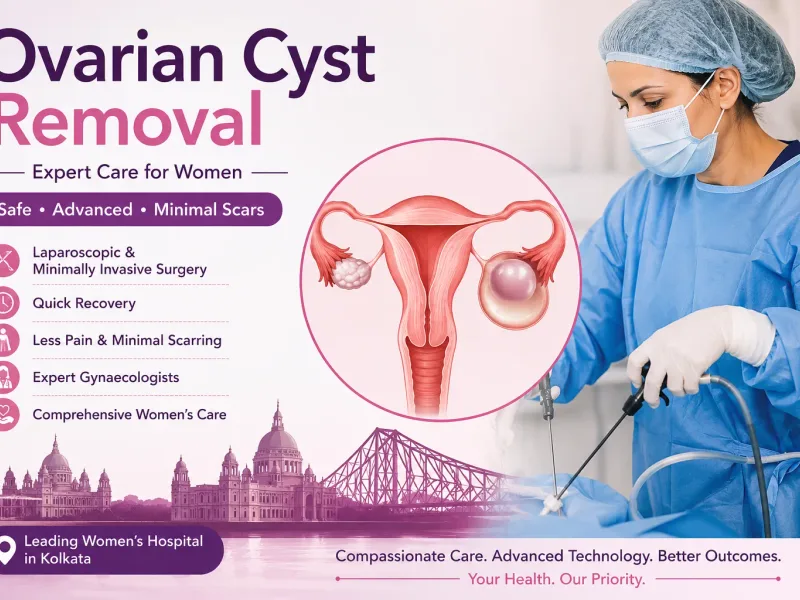
An ovarian cyst is a fluid-filled sac that forms on or inside an ovary, most often as a normal part of the menstrual cycle. Most cysts are functional, meaning they form during ovulation and shrink within a few weeks without any treatment. Surgery, known as an ovarian cystectomy, is typically only recommended when a cyst is large, doesn't go away on its own, or shows features that need closer evaluation. If you're searching for a women's doctor for ovarian cyst removal in Kolkata, this article walks through when surgery is actually needed, what the procedure involves, and how to choose the right gynecologist for your care.
[REVIEWER: add clinical insight here — e.g., how often you personally see functional cysts resolve without intervention versus cases where surgery becomes necessary]
Ovarian cysts can form for several reasons, and not all of them are related to your period:
Functional cysts — follicular or corpus luteum cysts that form during normal ovulation
Endometriomas — often called "chocolate cysts," these form when tissue from endometriosis attaches to the ovary
Cystadenomas — fluid-filled cysts that grow on the surface of the ovary
Dermoid cysts (mature cystic teratomas) — contain tissue such as hair or skin and aren't linked to the menstrual cycle
PCOS-related cysts — multiple small follicles caused by hormonal imbalance
Hormonal imbalances, pregnancy, endometriosis, and pelvic infections can all contribute to cyst formation.
Many ovarian cysts cause no symptoms at all and are only discovered incidentally during imaging or a routine pelvic exam. When symptoms do occur, they commonly include one-sided pelvic pain, bloating, pressure, or discomfort during sex, particularly around your period or ovulation.
Some symptoms need urgent attention, not just a routine appointment. Sudden, severe pain accompanied by dizziness, fever, or vomiting can mean the cyst has ruptured or that the ovary has twisted (a condition called torsion). Without prompt medical care, this can lead to heavy internal bleeding or infection, so don't wait it out if these symptoms appear.
A pelvic exam and pregnancy test usually come first, followed by a pelvic ultrasound to check the cyst's size, location, and whether it's fluid-filled or solid. Solid or partially solid cysts get closer scrutiny, since these are more likely to need removal as a precaution. In some cases, your doctor may also order blood tests, such as a CA-125 marker, especially if there's any concern about cancer risk.
Doctors generally recommend an ovarian cystectomy when a cyst is larger than about 2.5 to 3 inches wide, causes ongoing pain, keeps coming back, or shows features suggestive of malignancy. Cysts found during pregnancy are handled with extra care — most are functional and resolve on their own, though larger cysts prone to torsion, generally those over 6 cm, are more likely to require surgery.
If you've been told you need surgery, that doesn't automatically mean something is seriously wrong — many cystectomies are precautionary. Still, it's a decision worth making with a gynecologist who takes time to explain your specific ultrasound findings and risk factors.
The two surgical options for ovarian cyst removal are laparoscopy and laparotomy, and the choice depends mainly on the size of the cyst and whether cancer is suspected.
Laparoscopic cystectomy is the minimally invasive option and is preferred whenever it's a safe choice. It uses small incisions, typically around 5 millimeters, with a camera-equipped laparoscope inserted through the navel, and is usually completed under general anesthesia in one to two hours. Recovery is significantly shorter than with open surgery, with most patients returning to normal activity within one to three weeks, and same-day discharge is often possible.
Open surgery (laparotomy) involves a larger abdominal incision and is generally reserved for very large cysts or cases where cancer is a concern. Recovery from a laparotomy can take up to eight weeks.
[REVIEWER: add clinical insight here — e.g., how you decide between the two approaches for a specific patient, or common recovery challenges patients don't expect]
Your care team will typically give clear instructions on preoperative steps, such as when to stop eating and drinking, usually six to eight hours before the procedure, and may schedule presurgical testing or an anesthesia consultation beforehand. Plan to have someone drive you home and stay with you afterward, since recovery time depends heavily on which type of procedure you have.
It's reasonable to ask your surgeon directly about fertility preservation, especially if you're planning a future pregnancy — laparoscopic cystectomy is generally associated with better preservation of ovarian tissue than open surgery.
Kolkata has a mix of government medical college hospitals and private multi-specialty centers with dedicated gynecology and obstetrics departments, so you generally have a real choice rather than one default option. When narrowing down a gynecologist or gynecologic surgeon, a few things are worth checking:
Qualifications and registration — confirm the doctor holds a recognized MD/MS or DGO in Obstetrics & Gynecology and is registered with the West Bengal Medical Council
Surgical experience specifically with laparoscopic cystectomy, not just general gynecology — ask directly how many procedures they perform in a typical year
Hospital infrastructure — whether the hospital has an ICU, blood bank, and anesthesia team on-site, in case complications arise
Willingness to explain your ultrasound and any cancer-risk markers in plain language, rather than rushing you toward surgery
Second-opinion friendliness — a good surgeon won't discourage you from getting a second opinion before a major procedure
[REVIEWER: add clinical insight here — e.g., what a first consultation for suspected ovarian cyst typically covers in your practice, or what documents/reports a patient should bring]
Not every ovarian cyst needs a doctor's intervention, and not every recommendation for surgery is a cause for alarm — most cystectomies are precautionary and use minimally invasive techniques with a short recovery. What matters most is getting an accurate ultrasound read, understanding why surgery is (or isn't) being recommended in your case, and choosing a gynecologic surgeon in Kolkata with real experience in laparoscopic cyst removal. If you notice sudden, severe pelvic pain with fever, dizziness, or vomiting, treat it as an emergency and seek care immediately rather than waiting for a scheduled appointment.
Do all ovarian cysts need surgery? No. Most ovarian cysts are functional and shrink on their own within a few menstrual cycles. Surgery is usually only considered for cysts that are large, persistent, solid or partially solid, or causing significant symptoms.
How long does recovery take after ovarian cyst removal? It depends on the surgery type. Laparoscopic cystectomy typically allows a return to normal activity within one to three weeks, while recovery from open surgery (laparotomy) can take up to eight weeks.
Can I still get pregnant after ovarian cyst removal? Laparoscopic cystectomy is generally designed to preserve healthy ovarian tissue and fertility. Your surgeon can discuss your individual fertility outlook based on cyst type, size, and which ovary is involved.
What symptoms mean I should go to the hospital immediately? Sudden, severe pelvic pain along with fever, dizziness, rapid breathing, or vomiting can indicate a ruptured cyst or ovarian torsion, both of which need emergency care.
How do I know if my ovarian cyst is cancerous? Most ovarian cysts are benign. Doctors assess cancer risk using ultrasound features (solid vs. fluid-filled), size, growth pattern, and sometimes a CA-125 blood test, alongside your age and family history.
Visit Hospital
Near You

A cesarean section (C-section) is a surgical delivery in which a baby is born through an incision in the mother's abdomen and uterus. In Kolkata, several experienced obstetricians and well-equipped hospitals offer C-section services for planned and emergency deliveries. Understanding when a C-sectio
July 31, 2026

If you are searching for a Menstrual Disorders in Adolescent Girls Doctor in Kolkata, early evaluation by an experienced gynecologist can help identify the underlying cause of irregular or painful periods. While menstrual irregularities are common during the first few years after puberty, persistent
July 31, 2026

If you are searching for a Fibroid & Endometriosis doctor in Kolkata, choosing an experienced gynecologist with expertise in minimally invasive gynecological surgery is essential. Uterine fibroids and endometriosis are two common but different conditions that can cause pelvic pain, heavy menstrual b
July 31, 2026