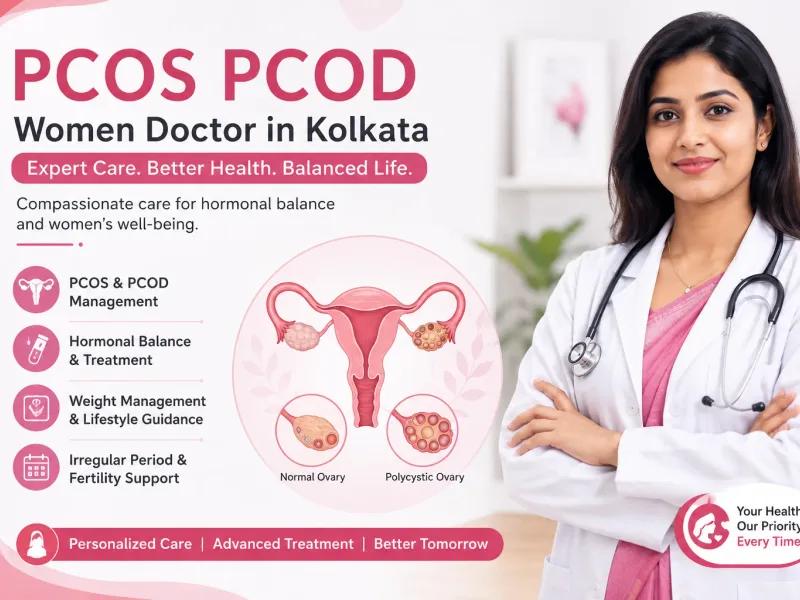
PCOD (polycystic ovarian disease) and PCOS (polycystic ovary syndrome) both involve the ovaries producing extra, partially formed egg follicles instead of releasing mature eggs each cycle. <cite index="5-1">PCOD is generally considered milder and easier to manage, since ovulation still tends to happen, while PCOS is a more complex, chronic hormonal and metabolic disorder that often disrupts ovulation more severely</cite>. If you're in Kolkata searching for a doctor to sort out which one you have, the short version is: a gynaecologist is the right first stop for both.
The names sound almost interchangeable, and the symptom lists overlap heavily — irregular periods, acne, weight gain, excess facial or body hair. <cite index="10-1">The two conditions differ mainly in severity and long-term impact: PCOD is a disorder mainly affecting the ovaries and cysts, typically easier to manage with lifestyle changes, while PCOS is a syndrome affecting multiple body systems, including hormonal imbalance, insulin resistance, and metabolic disruption</cite>.
[REVIEWER: add clinical insight here — e.g., how you personally distinguish PCOD from PCOS in a first consultation, or a common misconception patients bring in]
<cite index="6-1">In both conditions, a hormonal imbalance pushes the ovaries to produce slightly more androgens (male hormones) than normal, which interferes with the menstrual cycle and shows up as acne, extra hair growth, or irregular periods</cite>. With PCOS specifically, <cite index="6-1">many patients also develop insulin resistance, where cells stop responding properly to insulin, causing excess insulin in the blood, and the combination of high insulin and high androgens is what drives the longer-term health risks</cite>.
Mayo Clinic's patient materials describe it plainly: <cite index="13-1">PCOS is a hormonal disorder common among women of reproductive age, where the ovaries may develop numerous small fluid-filled follicles and fail to regularly release eggs, and the exact cause remains unknown</cite>. Worth noting for anyone researching this online: Mayo Clinic has recently updated its terminology for the condition on some of its patient pages, so you may see it referenced under a newer name in addition to PCOS — the underlying condition being described is the same.
How Common Is This, and Who Gets It
<cite index="18-1">PCOS affects roughly 5 to 20% of women of reproductive age and is a major cause of hirsutism and anovulatory infertility</cite>, and it isn't purely a reproductive issue — <cite index="18-1">it's linked to a wider range of metabolic problems including glucose intolerance, diabetes, high cholesterol, high blood pressure, and fatty liver</cite>. <cite index="18-1">Family history plays a role too: research suggests that up to a third of women with PCOS have a close relative with the condition</cite>.
How a Doctor Actually Diagnoses PCOS or PCOD
This is where a lot of self-diagnosis from symptom-checking goes wrong — there's no single blood test that confirms it. <cite index="17-1">PCOS is diagnosed when a person has at least two of three things: irregular periods, excess testosterone confirmed by a blood test, and, on ultrasound, ovaries containing many small immature follicles</cite>. <cite index="17-1">A transvaginal ultrasound is typically used to check the ovaries and the uterine lining, and additional blood work often screens for related issues like thyroid problems, since several conditions can mimic PCOS symptoms</cite>.
This is exactly why the diagnosis needs a qualified gynaecologist or endocrinologist rather than a symptom checklist off the internet — the same three or four symptoms can point to several different underlying conditions.
[REVIEWER: add clinical insight here — e.g., a red flag symptom pattern that should prompt an urgent visit rather than a routine one]
Choosing a PCOS/PCOD Doctor in Kolkata: What to Actually Check
Kolkata has no shortage of gynaecologists advertising PCOS and PCOD treatment, which makes the choice harder, not easier. A few practical filters help narrow it down:
Qualifications first. Look for an MBBS with an MD or DGO/DNB in Obstetrics & Gynaecology, ideally with additional fellowship training or memberships (such as FRCOG or similar recognised bodies) if fertility or complex hormonal cases are involved.
Hospital affiliation matters for follow-up care. Several of Kolkata's larger multi-specialty hospitals — including Apollo Multispeciality Hospitals, AMRI Hospitals, CK Birla Hospitals (CMRI), Fortis Hospital Anandapur, and Techno India DAMA Hospital — run dedicated gynaecology or women's health departments with in-house ultrasound and endocrinology support, which is useful since PCOS/PCOD workups usually need both.
Ask what the first visit includes. A thorough first consultation should cover a detailed menstrual and family history, a physical exam, and a plan for blood tests and ultrasound — not just a prescription on the first visit.
For fertility concerns, ask directly about experience with PCOS-related infertility, since management differs depending on whether ovulation is still happening.
Read reviews with a critical eye. Patient reviews on hospital or directory sites are useful for gauging bedside manner and clinic organisation, but they aren't a substitute for checking registered qualifications, which are publicly listed by the West Bengal Medical Council.
[REVIEWER: add clinical insight here — e.g., what patients in Kolkata most often get wrong about choosing a specialist, or how you'd advise someone comparing a gynaecologist versus an endocrinologist for their specific symptoms]
Living With PCOS or PCOD: What Treatment Usually Looks Like
Treatment is rarely just one thing. <cite index="7-1">Oral contraceptive pills, containing estrogen and a progesterone-like hormone, are commonly used to stabilise the menstrual cycle and manage several symptoms at once</cite>, alongside medication to manage related risks like diabetes. <cite index="7-1">Losing weight and adopting healthier lifestyle habits generally improves the overall outlook</cite>. For fertility specifically, most cases are manageable — <cite index="7-1">in Indian patients, around 20% of PCOD/PCOS-related fertility cases need fertility drugs or additional treatment to help with conception, based on available data</cite>, meaning the large majority don't need aggressive intervention.
Frequently Asked Questions
Is PCOD more serious than PCOS? No — it's generally the other way round. <cite index="4-1">PCOD is nowhere near as severe as PCOS, and mostly relates to lifestyle factors, while PCOS stems from more complex hormonal imbalances</cite> affecting the whole body, not just the ovaries.
Can I get pregnant with PCOS or PCOD? Often, yes. <cite index="5-1">Women with PCOD usually have normal ovulation and can conceive naturally after lifestyle changes</cite>, while PCOS may need more medical support depending on how much it affects ovulation. A gynaecologist can assess this specifically for your case.
What tests will a doctor in Kolkata run for PCOS/PCOD? Expect a menstrual and medical history review, a physical exam, blood tests for hormones (including testosterone and thyroid), and a pelvic or transvaginal ultrasound to check the ovaries. Some hospitals bundle these into a single PCOS work-up package.
Should I see a gynaecologist or an endocrinologist first? <cite index="22-1">A gynaecologist handles the reproductive health, menstrual, and fertility side, while an endocrinologist focuses on the hormonal and metabolic side, such as insulin resistance</cite>. Most people start with a gynaecologist, who will refer you onward if needed.
Does PCOS go away on its own? No, it's a long-term hormonal condition that's managed rather than cured. With the right combination of lifestyle changes and medical treatment, symptoms and long-term risks can be controlled effectively.