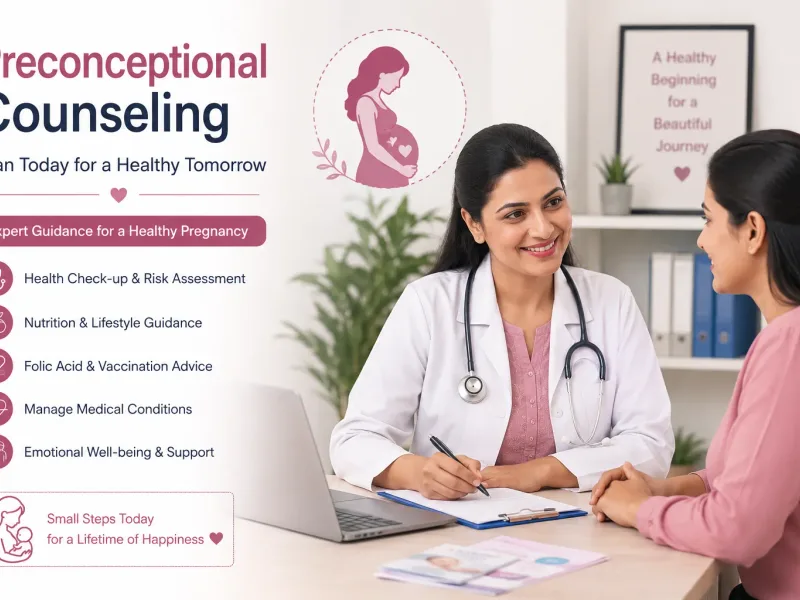
Preconceptional counseling is a medical visit for women — and ideally their partners — who are planning a pregnancy, held before conception rather than after. <cite index="7-1">It typically covers chronic conditions such as diabetes, hypertension, psychiatric illness, and thyroid disease, which can affect pregnancy outcomes and should be managed before pregnancy begins.</cite> The goal is simple: catch and correct health issues while they're still easy to fix, instead of during the first trimester when options narrow.
Many women assume prenatal care starts once a pregnancy test turns positive. But <cite index="5-1">the first weeks of pregnancy are when neural tube defects can form, often before a woman even realizes she's pregnant</cite> — which is exactly why this counseling happens beforehand, not after.
[REVIEWER: add clinical insight here — e.g., a common misconception patients have about when to start planning, or a pattern you see often in consultations]
Preconceptional counseling isn't only for women with existing health conditions. <cite index="9-1">Counseling can begin with a simple question a doctor might ask any reproductive-age patient: "Would you like to become pregnant in the next year?"</cite> That single question opens the door to a broader conversation, regardless of whether the woman is currently pregnant, using contraception, or just thinking ahead.
It's especially useful for:
Women with diabetes, high blood pressure, thyroid disorders, or a psychiatric condition
Women with a family history of genetic disorders
Women over 35, or with a history of pregnancy loss
Couples where either partner has a chronic infection or a family history of inherited blood disorders
Anyone unsure about their vaccination status for rubella or varicella
A typical preconception visit is part conversation, part screening. Here's what a gynecologist usually covers:
Health History and Chronic Conditions
The doctor reviews any ongoing conditions and adjusts medications if needed. <cite index="9-1">Because health status and risk factors change over time, this counseling is meant to happen more than once across a woman's reproductive years — not as a single one-time checklist.</cite>
Vaccination Status
<cite index="5-1">Immunity to rubella, varicella, and hepatitis B is usually checked, and doctors often recommend updating other vaccines before conception.</cite> Some vaccines can't be given during pregnancy, so this step only works if it happens in advance.
Folic Acid Supplementation
This is one of the most well-established parts of preconception care. <cite index="11-1">Women who can become pregnant are generally advised to take 400 mcg of folic acid daily, a recommendation supported by major public health bodies</cite>, because <cite index="12-1">supplementation needs to start at least a month before conception and continue through the first two to three months of pregnancy to be effective</cite>. Women who've previously had a pregnancy affected by a neural tube defect are typically advised on a higher, doctor-supervised dose.
Genetic and Carrier Screening
For couples with a family history of inherited conditions, <cite index="6-1">carrier screening for conditions like sickle cell disease and thalassemia may be recommended, especially for those of African, Southeast Asian, or Mediterranean descent, with genetic counseling offered if both partners test positive</cite>. In India, thalassemia carrier screening is a routine and important part of this conversation given the population's carrier rates.
Infection and STI Screening
<cite index="5-1">Screening for chlamydia, gonorrhea, syphilis, HIV, and hepatitis B and C may be recommended depending on age and risk factors.</cite>
Lifestyle and Nutrition
<cite index="5-1">A healthy diet with fruits, vegetables, and whole grains is encouraged, along with a daily multivitamin, while excess intake of fat-soluble vitamins A, D, E, and K is discouraged since they can build up in tissue.</cite> Smoking, alcohol use, and recreational drug use are also addressed directly. <cite index="15-1">Drinking alcohol, smoking, and using certain drugs during pregnancy can lead to premature birth, birth defects, or infant loss, so doctors raise this before conception whenever possible.</cite>
Mental Health and Safety Screening
<cite index="7-1">Screening for intimate partner violence is also part of standard prepregnancy counseling</cite>, alongside routine questions about substance use.
[REVIEWER: add clinical insight here — e.g., what a first preconception visit at your clinic typically looks like, or a common finding you see in patients from Kolkata]
Why the Timing Matters
The window before conception is short but consequential. <cite index="12-1">Folic acid supplementation needs about a month's head start to build up protective levels before conception</cite>, and several vaccines require weeks to become effective and can't be administered once pregnancy begins. Waiting until the first missed period to address these issues means some of the most protective interventions are no longer possible.
Finding a Preconceptional Counseling Doctor in Kolkata
Preconceptional counseling in Kolkata is typically offered by obstetrician-gynecologists (OB-GYNs) as part of a pre-pregnancy or well-woman consultation, rather than as a separately branded service — so the most direct route is to ask a practicing gynecologist for a "preconception" or "pre-pregnancy" checkup rather than searching for the term as a standalone specialty.
When choosing a doctor, it helps to ask:
Do they routinely screen for thalassemia carrier status, common in West Bengal?
Do they check vaccination history and recommend folic acid before conception, not just after a positive test?
Do they involve your partner in the conversation when relevant (for genetic or infection screening)?
Is there a clear plan for managing any existing condition, such as thyroid disease or diabetes, before you try to conceive?
Reputable multi-specialty hospitals and maternity centers in Kolkata generally list obstetrics and gynecology departments where this consultation can be booked; a referral from a family physician is also a reliable starting point if you're unsure who to approach first.
Frequently Asked Questions
What is the right time to start preconceptional counseling? Ideally, at least 3 months before you plan to conceive. This gives enough time for vaccinations to take effect, folic acid levels to build up, and any chronic condition to be brought under control before pregnancy begins.
Is preconceptional counseling only for women with health problems? No. It benefits any woman planning a pregnancy, including those with no known conditions. A doctor may simply confirm your vaccination status, start you on folic acid, and review your family history.
Does preconceptional counseling involve my partner? Often, yes — particularly for genetic carrier screening and infection testing, where results from both partners are needed to assess risk to a future pregnancy accurately.
How much folic acid should I take before pregnancy? Most women are advised 400 mcg daily starting at least a month before conception. Women with a prior pregnancy affected by a neural tube defect may be advised a higher dose, but this should be decided with a doctor, not self-prescribed.
Is thalassemia screening necessary for couples in Kolkata? It's commonly recommended in West Bengal given regional carrier rates, and your gynecologist can advise whether testing is appropriate for you and your partner based on family history and local guidelines