

Emergency & Help
24/7 Emergency & General Advisory
🚨 24/7 Medical Emergency
Non-Emergency Advisory
10:00 AM – 6:00 PM, Mon–Sat
For appointments & general queries.
24/7 Emergency & General Advisory
🚨 24/7 Medical Emergency
Non-Emergency Advisory
10:00 AM – 6:00 PM, Mon–Sat
For appointments & general queries.
Stay updated with our latest healthcare news and your appointments.
Avoiding anxiety-provoking situations feels like relief — but it's actually the mechanism that makes anxiety chronic. Understanding and interrupting the anxiety-avoidance cycle is the foundation of every effective psychological treatment for anxiety disorders.
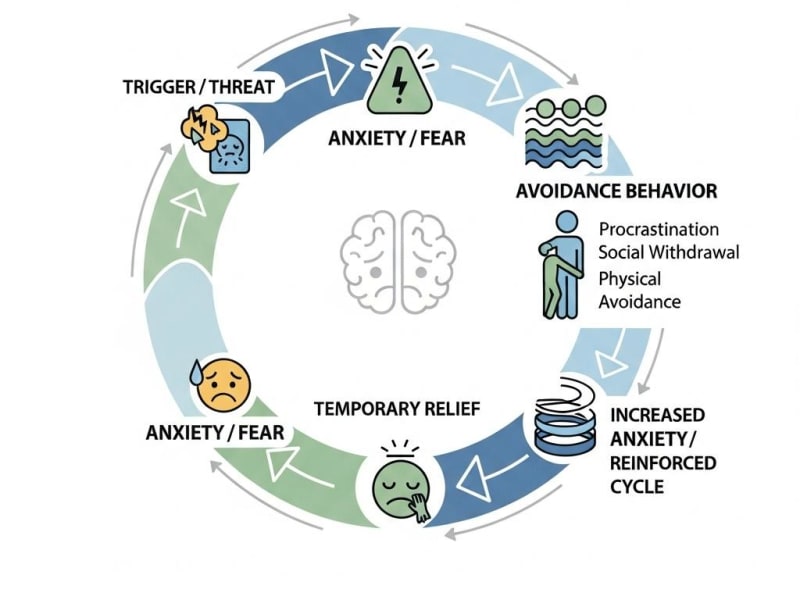
Avoidance provides short-term anxiety relief but makes anxiety worse long-term. Learn how to break this cycle using evidence-based psychological techniques.
Anxiety is a survival mechanism — a neurological warning system that primes the body for threat response. The problem arises not from anxiety itself but from the behavioural response it generates: avoidance. When we avoid situations, thoughts, or feelings that trigger anxiety, we experience immediate relief — and this relief powerfully reinforces the avoidance behaviour. Over time, the anxiety-avoidance cycle tightens until the range of "safe" situations narrows progressively. Breaking this cycle is the central objective of every evidence-based anxiety treatment.
The cycle follows a consistent pattern: an anxiety-provoking trigger (external situation, internal thought, or bodily sensation) generates fear → the person avoids the trigger → anxiety decreases immediately → the brain learns that avoidance = safety → the trigger becomes more threatening → avoidance becomes more compulsive.
This is the operant conditioning mechanism at the heart of anxiety disorders. Avoidance prevents what psychologists call "extinction learning" — the neurological process by which the brain updates its threat appraisal of a stimulus based on experience. When you avoid, the brain never receives the updated information that the threat was survivable or exaggerated. Each avoidance episode strengthens the threat response.
Safety behaviours — subtle avoidance strategies like checking, seeking reassurance, carrying "just in case" items, or over-preparing — maintain the cycle even when full avoidance isn't practised.
The gold-standard treatment for anxiety is Exposure and Response Prevention (ERP) — systematic, gradual confrontation of feared situations or stimuli without engaging in avoidance or safety behaviours. This applies across anxiety disorders: social anxiety, OCD, phobias, health anxiety, and generalised anxiety disorder.
Practical steps for self-directed exposure:
Build a fear hierarchy: List anxiety-provoking situations from least to most distressing, rating each 0–10. Begin at the bottom.
Practise graduated exposure: Deliberately enter lower-ranked feared situations and remain in them until anxiety peaks and naturally decreases (typically 20–45 minutes). This process is called habituation.
Drop safety behaviours: Each time you face the feared situation, identify and remove the subtle security props — they prevent full extinction learning.
Repeat until mastery: Move up the hierarchy only after lower-level exposures produce minimal anxiety. Rushing produces incomplete extinction.
Tolerate uncertainty: Anxiety's fuel is often intolerance of uncertainty — the compulsive need to know outcomes. Willingness to tolerate "I don't know" is itself a therapeutic tool.
Exposure works best when combined with cognitive restructuring from CBT — identifying the catastrophic predictions that drive avoidance ("If I speak up in the meeting, I will humiliate myself") and evaluating them against evidence. The behavioural experiment model tests these predictions directly through exposure, generating experiential evidence that updates the belief.
The anxiety-avoidance cycle is self-reinforcing, but it is also self-correctable with the right approach. Every act of intentional approach — facing what you fear in a graduated, deliberate way — weakens the cycle and expands your functional world. If self-directed exposure feels insufficient, working with a CBT therapist trained in ERP is among the most evidence-supported interventions in all of mental healthcare.
1. What is the anxiety-avoidance cycle?
A pattern where avoiding fear gives short-term relief but makes anxiety stronger over time.
2. How can you break this cycle?
By gradually facing fears (exposure) instead of avoiding them.
3. Why is avoidance harmful?
Because it prevents your brain from learning that the fear is manageable or not dangerous.
Author: Doctar Team
Disclaimer: For more information contact Doctar Team
Visit Hospital
Near You
Discover effective stroke rehabilitation in Alipurduar. Learn about therapies, recovery strategies, and finding the right care for regaining independence.
May 20, 2026
Discover how to find a top obstetrician in Madhyamgram. Learn key factors and what to look for in maternal care.
May 20, 2026
Find top diabetes clinics in Purba Medinipur. Get expert endocrinologists, advanced treatments, and comprehensive diabetes management.
May 20, 2026