

Emergency & Help
24/7 Emergency & General Advisory
🚨 24/7 Medical Emergency
Non-Emergency Advisory
10:00 AM – 6:00 PM, Mon–Sat
For appointments & general queries.
24/7 Emergency & General Advisory
🚨 24/7 Medical Emergency
Non-Emergency Advisory
10:00 AM – 6:00 PM, Mon–Sat
For appointments & general queries.
Stay updated with our latest healthcare news and your appointments.
Gratitude practices have moved from self-help cliché to serious neuroscience. Brain imaging studies, randomised trials, and neurochemical research now reveal how consistent gratitude practice physically alters neural circuits linked to mood, anxiety, and social connection.
Gratitude is more than a positive feeling — it triggers measurable neurological changes. Discover what brain science says about gratitude and mental wellbeing.
Gratitude has been celebrated across philosophical traditions for millennia — but it's only in the past two decades that neuroscience has begun to explain why it works. Brain imaging studies, neurochemical research, and randomised controlled trials have transformed gratitude from a philosophical virtue into a measurable psychological intervention with demonstrable effects on brain structure, function, and mental health outcomes. The neuroscience of gratitude is one of the most compelling areas of positive psychology research.
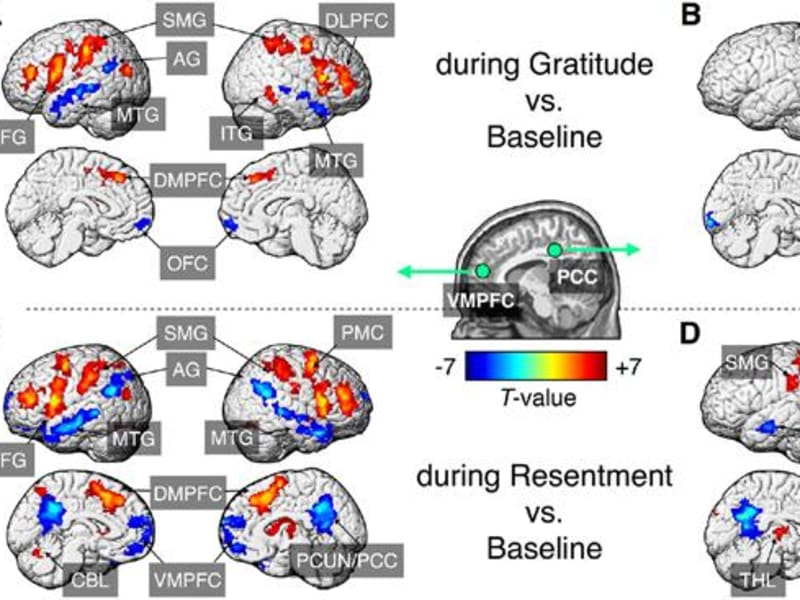
Functional MRI studies have identified the neural correlates of gratitude with increasing precision. When people experience and express genuine gratitude, activation occurs primarily in:
The medial prefrontal cortex: Associated with moral cognition, social connection, and interpersonal reward. Gratitude effectively recruits the brain's social bonding circuitry.
The anterior cingulate cortex: Involved in emotional regulation and empathy. Gratitude appears to modulate emotional responses to others' actions.
The ventral tegmental area and nucleus accumbens (reward pathway): Gratitude activates dopaminergic reward circuits, similar to other social rewards. This helps explain the intrinsically motivating quality of grateful experiences.
A pioneering study by Yu-Ting Chen and colleagues used fMRI to show that participants who practised gratitude letters (expressing thanks to others) showed significantly greater neural activation in gratitude-associated regions compared to control tasks — and these changes persisted weeks after the exercises ended. This suggests that gratitude practice induces lasting neural change, not merely momentary mood elevation.
A landmark RCT by Wong and Brown (2018) found that writing gratitude letters in addition to psychotherapy produced significantly better mental health outcomes than psychotherapy with no gratitude writing — and brain scans showed greater medial prefrontal cortex activation three months later in the gratitude group
Regular gratitude practice is associated with increased serotonin synthesis in the anterior cingulate cortex (a finding drawn from gratitude's overlap with self-reflection circuits)
A meta-analysis published in Psychological Bulletin found consistent associations between gratitude and reduced depressive symptoms, reduced anxiety, improved sleep quality, and enhanced wellbeing across 70+ studies
Gratitude activates oxytocin release pathways, supporting social bonding and reducing stress-related cortisol output
Not all gratitude practices are equal in their neurological impact. Research indicates:
Specificity beats volume: Writing in detail about one thing you're grateful for produces stronger neural response than listing five items superficially
Novelty matters: The brain adapts to repeated stimuli; varying the focus of gratitude maintains potency
Expressing gratitude to others produces significantly stronger activation than private reflection — the social dimension amplifies the neurological effect
Consistency builds neuroplasticity: Benefits compound over 4–8 weeks of regular practice; occasional gratitude journaling produces smaller effects than a daily or three-times-weekly practice
The neuroscience of gratitude confirms what ancient wisdom intuited: actively cultivating thankfulness reshapes the brain's emotional architecture. For a five-minute daily practice with measurable effects on depression, anxiety, sleep, and social connection, the cost-benefit analysis is unambiguous. Start with one specific, detailed entry per day — and direct that gratitude outward when possible.
1. How does gratitude affect the brain?
It activates reward and emotion-regulation areas, improving mood and social connection.
2. Can gratitude improve mental health?
Yes, it reduces stress, anxiety, and depression while boosting overall wellbeing.
3. What is the best way to practice gratitude?
Write specific, meaningful things regularly and express them to others.
Author: Doctar Team
Disclaimer: For more information contact Doctar Team.
Visit Hospital
Near You
Discover effective stroke rehabilitation in Alipurduar. Learn about therapies, recovery strategies, and finding the right care for regaining independence.
May 20, 2026
Discover how to find a top obstetrician in Madhyamgram. Learn key factors and what to look for in maternal care.
May 20, 2026
Find top diabetes clinics in Purba Medinipur. Get expert endocrinologists, advanced treatments, and comprehensive diabetes management.
May 20, 2026