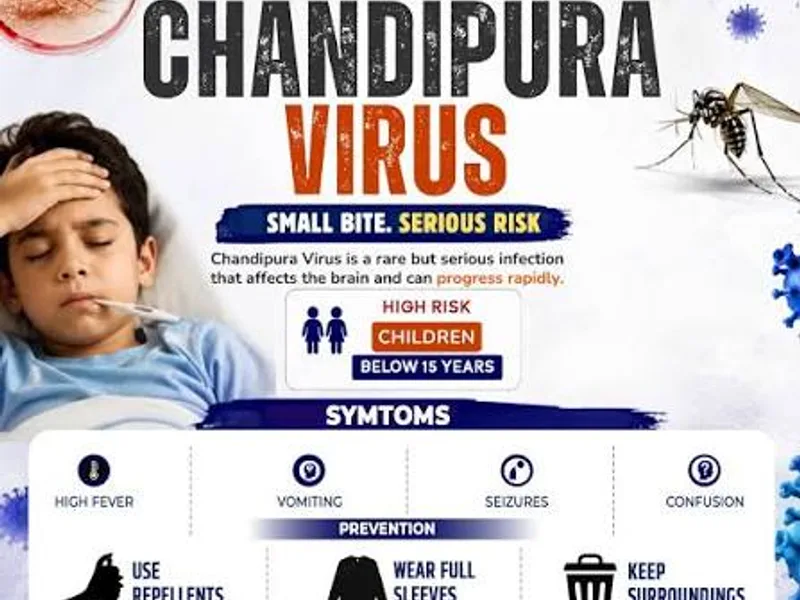
Chandipura Virus Outbreak: Why Children Are at the Center of This Crisis
A fever that looks completely ordinary on day one can, in a small number of Chandipura cases, become a medical emergency by day two. That's the uncomfortable fact driving this year's outbreak in Gujarat, and it's why the case numbers alone don't tell the full story.
As of early August 2026, Gujarat's health department had confirmed 35 laboratory-positive cases of Chandipura virus out of 184 suspected cases, almost entirely in children. Twenty-two of those children have died. The outbreak started in the first week of July and has spread with sporadic cases into Rajasthan, prompting the Union Health Ministry to deploy a National Joint Outbreak Response Team to both states.
What Chandipura Virus Actually Is
The disease can progress to acute encephalitis syndrome (AES) — a broad category covering conditions where the brain becomes inflamed or stops functioning normally. Doctar's guide to understanding fever has more on how fever itself works as a symptom, but the important distinction here is that Chandipura isn't "just a fever" once it turns neurological.
Chandipura virus belongs to the same broad family as rabies, though the disease it causes is entirely different. It spreads mainly through infected sandflies rather than person-to-person contact, which changes how families should think about protection — this isn't a flu-style outbreak where isolating a sick child helps. Some mosquitoes and other insects have been investigated as possible secondary carriers, but sandflies remain the dominant public-health concern, similar in principle to how other insect-borne illnesses covered in Doctar's piece on why you shouldn't fear mosquitoes for HIV — but should for other diseases work through a vector rather than direct contact.
Why Children Bear the Brunt
Nearly every severe Chandipura case involves a child, and the exact reason for that age pattern still isn't fully understood. What is understood is the timeline: fever and headache can progress to vomiting, altered behavior, seizures, and reduced consciousness, sometimes within a day or two.
In clinical practice, the hard part usually isn't spotting a fever — parents catch that immediately. It's recognizing when a child's alertness or behavior has genuinely changed, as opposed to the normal crankiness that comes with any illness. A child who becomes unusually sleepy, hard to rouse, or confused after developing fever needs more urgent attention than a child with an isolated mild fever who's otherwise acting like themselves.
These symptoms overlap heavily with other conditions, which is exactly why professional evaluation matters more than guesswork at home. Doctar's guide to pediatric neurological disorders explains why neurological symptoms in children can be genuinely difficult to interpret even for experienced parents.
Encephalitis, Meningitis, and Why the Difference Matters
Encephalitis means the brain tissue itself is inflamed. Meningitis affects the membranes surrounding the brain and spinal cord instead. The two conditions share overlapping symptoms — fever, headache, vomiting, confusion, seizures — which is part of why lab testing and clinical assessment matter more than symptom-spotting alone. Doctar's detailed comparison of encephalitis and meningitis walks through how doctors tell them apart.
Vomiting alone, it's worth saying plainly, does not mean Chandipura. Plenty of far more common childhood illnesses cause vomiting, and turning every stomach bug into a Chandipura scare helps no one.
Is It Contagious?
Not in the way most people assume. Chandipura is a vector-borne disease, spread through insect bites rather than the kind of close contact that spreads a cold or flu. That distinction should shape the response: reducing sandfly exposure matters far more than avoiding other people.
Doctar's guide on mosquito bites in babies covers practical insect-bite protection for the youngest, most vulnerable family members, which applies just as well to sandfly exposure as it does to mosquitoes.
What the Government Response Looks Like
On the ground in Gujarat, the health department has advised residents to seal cracks in mud walls — a known sandfly breeding site — and has ramped up insecticide spraying around cattle-rearing zones. The national response includes surveillance, vector investigation, and what officials describe as a "One Health" approach that looks at human, animal, and environmental factors together rather than treating this as a purely clinical problem.
What Parents Should Actually Watch For
Most childhood fevers, even during this outbreak, are not Chandipura. Respiratory infections and common viral illnesses remain far more likely causes, and Doctar's guide to pneumonia in children is a useful reminder that "fever plus feeling unwell" covers a lot of ordinary ground.
The pattern to actually worry about is different: a sudden change in alertness, repeated vomiting alongside severe illness, seizures, confusion, or difficulty waking a child. That combination needs same-day medical evaluation, not a wait-and-see approach.